# Tough Day
> Tough Day is an Employee Success Platform built around Tuffy, an AI Workplace Advisor that gives every employee confidential, 24/7 expert guidance to self-manage and succeed at work. Tough Day builds "Human-Positive AI" — technology designed to advance human agency and capability, not replace it.
Tuffy helps employees at every level navigate change and challenges, develop new capabilities, and build productive relationships — like a great manager and trusted thought partner in one. Managers and HR are freed from reactive problem-solving, and organizations can support and develop their people at scale. Tough Day is headquartered in New York City.
## Company
- [About](https://tough.day/about): Tough Day's vision, values, and leadership team.
- [Product](https://tough.day/product): What Tuffy, the AI Workplace Advisor, does and how it works.
- [Insights](https://tough.day/insights): All articles, podcasts, and news from Tough Day.
- [Contact](https://tough.day/contact): Get in touch or book a demo.
## Blog
- [You wouldn't hire a human without a job description, so why deploy AI without one?](https://tough.day/post/you-wouldnt-hire-a-human-without-a-job-description-so-why-deploy-ai-without-one): Wonder why leaders hire Tuffy AI to join their team? Here is Tuffy’s Job Description.
- [Nobel-Winning Economists Just Described the AI We're Building](https://tough.day/post/nobel-winning-economists-just-described-the-ai-were-building): Three MIT economists, including Nobel laureate Daron Acemoglu, just published a paper through the Brookings Institution making the case that the AI industry has a directional problem. Most AI investment flows toward replacing human expertise, not expanding it. They call the alternative "pro-worker AI." We agree with the direction. We think it should go further.
- [Creating Good Vibes at Work: People](https://tough.day/post/creating-good-vibes-at-work-people): What makes someone "awesome" at work isn't a universal standard, it's a reflection of culture. In this piece, we look at how high-performance environments can feel radically different from the inside, how culture shows up in the small everyday moments that shape belonging and growth, and why defining what "awesome" means to you can help you figure out where you'll actually thrive.
- [Creating Good Vibes at Work: Platform](https://tough.day/post/creating-good-vibes-at-work-platform): What makes work energizing? Platform. When a role is designed as a vehicle for growth — with daily learning, clear capability progression, and advocates who optimize for strengths — it builds forward motion. Purpose gives meaning. Platform provides the lift. When both are present, you feel it.
- [Creating Good Vibes at Work: Purpose](https://tough.day/post/creating-good-vibes-at-work-purpose): Good vibes at work come from three ingredients: belief in the company’s purpose, a role that fuels growth, and awesome people. Purpose is the why of work, and the reason a company exists. When work feels personal and meaningful, energy flows. Alignment between individual and company purpose is what turns a job into a worthy cause.
- [Cutting Managers Is the Easy Part: What Breaks and What Defines the Next Decade](https://tough.day/post/cutting-managers-is-the-easy-part): As companies flatten and cut management layers, they risk losing the human support managers were meant to provide. This piece explores what breaks in “manager-lite” organizations, and why redesigning support systems, powered by AI, will define the next era of work.
- [How Great Leaders Turn Feedback into Fuel](https://tough.day/post/how-great-leaders-turn-feedback-into-fuel): Learn how great leaders turn feedback from a dreaded event into fuel for growth by building systems that make honesty safe and learning routine.
- [Navigating Politics: How Smart Leaders Turn Unwritten Rules Into Real Results](https://tough.day/post/navigating-politics-turn-unwritten-rules-into-real-results): Self-leadership is the foundation of thriving in today’s workplace. Talent leaders can embed simple, scalable, high-impact practices to help employees build this muscle.
- [Rewiring Your Culture for Resilience](https://tough.day/post/rewiring-your-culture-for-resilience): Chronic stress rewires the brain. Learn how leaders can build stress tolerance and train resilience as a measurable workplace skill.
- [Leadership Lessons: What We Can Learn from Bad Bosses](https://tough.day/post/leadership-lessons-what-we-can-learn-from-bad-bosses): Bad boss behaviors are leadership curriculum hiding n plain sight. Best selling author, Mita Mallick, reveals how great leaders can turn them into lessons that build trust, reduce chaos, and create thriving teams.
- [The New Leadership Superpower: Regulating in High-Pressure](https://tough.day/post/the-new-leadership-superpower-regulating-in-high-pressure): The teams that will thrive are not the ones that avoid pressure. They are the ones whose leaders know how to regulate it. In periods of great change, a structured approach to regulation isn’t a “nice to have”, it’s how teams stay aligned, grounded, and able to adapt without burning out.
- [Busywork vs Flow: the Right Way to Prevent Burnout](https://tough.day/post/busywork-vs-flow-the-right-way-to-prevent-burnout): Some companies are bringing back busywork as "recovery time." That's backwards. AI isn't causing burnout, it's exposing how poorly we designed work in the first place.
- [The Little Things Matter: The Hidden Tax on Small Slights at Work](https://tough.day/post/the-little-things-matter-the-hidden-tax-on-small-slights-at-work): A late birthday card triggered a 50% spike in absenteeism. New Wharton research shows the hidden cost of small slights, and why most AI misses it entirely.
- [Are you using the right AI? Don’t settle for sycophantic bots. Introducing Human-Positive AI.](https://tough.day/post/are-you-using-the-right-ai-introducing-human-positive-ai): What kind of AI is your company using? Understanding this question can transform the value you get out of AI. Most platforms just validate employee impulses. Human-positive AI builds real competency.
- [From Leadership to Teamship: Why the Future of Work Belongs to Teams](https://tough.day/post/from-leadership-to-teamship-why-the-future-of-work-belongs-to-teams): Hero leadership is slowing you down. Learn how “teamship” and a few simple practices can be built into everyday work to supercharge teams.
- [The AI Paradox: How AI Can Make Human Interaction More Human](https://tough.day/post/the-ai-paradox): Discover how inserting AI into the right experiences can unlock more trust, clarity, and human connection in every interaction. Understanding this paradox can transform your business.
- [Unbossed and Ready: Why Self-Leadership Wins at Work](https://tough.day/post/unbossed-and-ready-why-self-leadership-wins-at-work): Self-leadership is the foundation of thriving in today’s workplace. Talent leaders can embed simple, scalable, high-impact practices to help employees build this muscle.
## Podcasts
- [The Atypical Achiever: Leading & Thriving When Your Brain Is Wired Differently](https://tough.day/post/the-atypical-achiever): Explore what it means to be neurodistinct and how to design a workplace that embraces our distinct needs and complementary super powers to achieve our goals.
- [Shift Happens: Embracing Change at Work](https://tough.day/post/shift-happens-embracing-change-at-work): Explore the nuances of navigating workplace transformations, from the historical roots of change management to the modern challenges posed by technology and AI.
- [The Power of the Pack](https://tough.day/post/the-power-of-the-pack): Hear from CEO, founder, and Chief Troublemaker of The Female Quotient, Shelley Zalis, about rewriting the rules of work for a more inclusive, human-centered future.
- [Unbossed: Mastering Self-Leadership in Today's Work Culture](https://tough.day/post/unbossed-mastering-self-leadership-in-todays-work-culture): Learn what it really means to lead yourself, including strategies for standing out, breaking through roadblocks, and mastering the mindset shifts that set top performers apart.
- [Wired for Resilience](https://tough.day/post/wired-for-resilience): Learn how to rewire your brain for adaptability, navigate stress, and future-proof your career in an era of uncertainty. Plus, navigating layoffs, burnout, and leading change without resistance.
- [Work in the Trump Era](https://tough.day/post/work-in-the-trump-era): Legal and workplace pros unpack upcoming shifts in workplace policies, labor relations, and the game-changing impact of AI on jobs, plus strategies for navigating political divides in the office.
- [Scents and Sensibility: What Your Nose Knows About Work](https://tough.day/post/scents-and-sensibility-what-your-nose-knows-about-work): Smell is a vital detail in office design that's often overlooked. Learn a science-backed framework for thinking about smell, stress, and space in a whole new way.
- [Super Human Skill: Storytelling](https://tough.day/post/super-human-skill-storytelling): In this episode, Joe talks about why storytelling isn’t a soft skill on the margins, it’s the foundational human capability that makes every other skill work better.
- [Leading with Empathy](https://tough.day/post/leading-with-empathy): Learn how cognitive empathy can create high-performing teams, the seven archetypes of empathy, and why asking better questions might be the key to your next career breakthrough.
- [Agree to Disagree](https://tough.day/post/agree-to-disagree): Explore what it actually takes to disagree well at work — and why productive friction might be the most underrated leadership skill nobody's talking about.
- [Antidote to Burnout](https://tough.day/post/antidote-to-burnout): We've all felt it—that Sunday dread, the flat feeling at your desk, the sense that your energy is running on empty and no one seems to notice. But what if burnout isn't just about working too hard? What if it's about working in the wrong direction?
- [Inspired and Inspiring Leadership](https://tough.day/post/inspired-and-inspiring): We've all been told "be more creative" or "think outside the box." But what does that actually mean—and how do you build a workplace where inspiration isn't just a buzzword, but the fuel that drives real results?
- [Balance and Burnout](https://tough.day/post/balance-and-burnout): Get tips for tackling tricky work situations, managing high-stress roles, creating a supportive work environment, and achieving balance in a competitive world.
- [Beyond Happiness in the Workplace](https://tough.day/post/beyond-happiness-in-the-workplace): Bestselling author and workplace happiness expert Jenn Lim reveals the secret to finding fulfillment — even in the most soul-sucking jobs.
- [Bridges, Chutes and Ladders](https://tough.day/post/bridges-chutes-and-ladders): Get insight into the twists and turns of internal mobility, from the benefits of taking on new roles within a company to how managers can encourage career growth.
- [Communication Gaps, Gaffes and Glory](https://tough.day/post/communication-gaps-gaffes-and-glory): In this episode, we breakdown the real reasons behind workplace miscommunication, explore the impact of remote work on effective collaboration, and talk about how storytelling can unite teams.
- [Cracking the Curiosity Code](https://tough.day/post/cracking-the-curiosity-code): Former CFO turned executive coach, Mike O'Reilly, explores how curiosity can fuel great leadership, create vibrant workplace cultures, and inspire personal growth.
- [Creativity at Work](https://tough.day/post/creativity-at-work): Whether you're a dreamer, a doer, or both, this episode is packed with inspiration for unleashing creativity under any constraint.
- [Cultivating an Everywhere Mindset](https://tough.day/post/cultivating-an-everywhere-mindset): Being globally curious isn’t just for digital nomads, it’s actually a career game-changer. Tune in to hear why grit and guts (aka “resilience” and “moxie”) matter more than ever.
- [From Bad Bosses to Great Leaders](https://tough.day/post/from-bad-bosses-to-great-leaders-2): Mita Mallick, bestselling author and workplace culture expert unpacks some of the most common (and quietly dangerous) archetypes of bad bosses - and what good leaders can learn from them.
- [From Leadership to Teamship](https://tough.day/post/from-leadership-to-teamship): Leadership expert and bestselling author Keith Ferrazzi dives into the biggest workplace transformations, the power of collaboration, and why traditional management is on its way out.
- [Giving and Receiving Feedback](https://tough.day/post/giving-and-receiving-feedback): Gain practical tips for navigating tough conversations and fostering professional growth, plus how to build a culture of constructive feedback and address workplace biases.
- [How to Create a Culture That Works](https://tough.day/post/how-to-create-a-culture-that-works): Learn the ins and outs of building an awesome corporate culture and get practical tips for defining company values, keeping employees engaged, and making culture a real part of everyday work.
- [How to Flex for Workforce Success](https://tough.day/post/how-to-flex-for-workforce-success): Dive into the highs and lows of flexible work, employee engagement, and tackling real-world workplace challenges — like navigating the awkward happy hour invite or overcoming the isolation of remote work.
- [Management as Caregiving](https://tough.day/post/management-as-caregiving): Learn how caregiving and leadership aren’t opposites, they’re deeply connected. If you've ever felt like managing people shouldn’t feel this hard, this one's for you.
- [Manager Excellence](https://tough.day/post/manager-excellence): Explore the evolution of managerial roles post-pandemic and learn practical strategies for fostering growth, building strong teams and navigating performance management.
- [Mirror, Mirror - the Power of Reflection](https://tough.day/post/mirror-mirror---the-power-of-reflection): Explore the power self-reflection, professional assessments, and why knowing your superpowers is the ultimate career hack, plus how to take and use good, bad and cringeworthy feedback.
- [Navigating Politics](https://tough.day/post/navigating-politics): Get practical advice and learn how to identify and tackle subtle gender biases, while leveraging the power of politics as a tool for organizational growth, from the authors of "You Should Smile More"
- [Policy Playbook](https://tough.day/post/policy-playbook): Take a surprisingly fun deep dive into… employee handbooks and learn practical tips for making these workplace “rule books” more human and a lot less boring.
- [Practice and Performance](https://tough.day/post/practice-and-performance): Dive into the art of building a performance-focused culture that thrives on honest feedback and continuous growth, including advice on navigating high-stakes projects and fostering accountability.
- [Why Most Change Fails and How to Make Yours Stick](https://tough.day/post/why-most-change-fails-and-how-to-make-yours-stick): Unpack what really makes change so hard for teams and leaders alike and explore why most change management efforts miss the mark.
- [Leading Under Pressure Without Losing Your Cool (or Your Team)](https://tough.day/post/leading-under-pressure-without-losing-your-cool-or-your-team): Explore what really happens when pressure becomes the norm at work and the hidden role of self-regulation in leadership.
## News
- [Charter Leadership Forum: What Older Workers Need to Navigate the AI Age](https://tough.day/post/charter-leadership-forum-what-older-workers-need-to-navigate-the-ai-age)
- [Founders Everywhere: Katherine von Jan](https://tough.day/post/founders-everywhere-katherine-von-jan)
- [Charter: Smart by design: Building Tuffy's brain](https://tough.day/post/charter-smart-by-design-building-tuffys-brain)
- [Band of Sisters press release](https://tough.day/post/band-of-sisters-press-release)
- [Listen Up With Auditive: Daniel Faddoul with Alberto Escalarte](https://tough.day/post/listen-up-with-auditive-daniel-faddoul-with-alberto-escalarte)
- [On Discourse: AI that makes us more human](https://tough.day/post/on-discourse-ai-that-makes-us-more-human)
- [AI for founders - This confidential AI will save your team from meltdowns](https://tough.day/post/ai-for-founders-june-2025)
- [The Intersect Podcast - May 15 2025](https://tough.day/post/the-intersect-podcast-burnout-and-ai-resilience-partner-for-the-workforce)
- [Pioneers of AI - Your next manager could be powered by AI](https://tough.day/post/pioneers-of-ai-podcast-march-2025)
- [Fisher Philips release](https://tough.day/post/fisher-phillips-september-2024)
- [Everywhere Ventures - Goodbye Tough Days](https://tough.day/post/everywhere-ventures-june-2024)
- [Built Right - Navigating Workplace Challenges with AI: The Tough Day Solution](https://tough.day/post/talking-ai-built-right-podcast-april-2024)
- [WSJ Tough Day feature](https://tough.day/post/wsj-march-2024)
## Optional
- [Privacy Policy](https://tough.day/privacy): How Tough Day collects, uses, and protects personal information.
- [Frank](https://frank.tough.day): A Tough Day companion tool for candid workplace feedback.
---
# Full content
## The Atypical Achiever: Leading & Thriving When Your Brain Is Wired Differently
URL: https://tough.day/post/the-atypical-achiever
Published: 2026-06-17
Category: podcast
Listen: https://open.spotify.com/embed/episode/78QRvlzVexcv0YfjRTI8XG?utm_source=generator&si=f0c5740970de46bf
Workplaces design for the "average" employee — fixed hours, open floors, one-size-fits-all motivation. But what if the average employee doesn't exist? In this episode of Tough Day’s Podcast, KVJ sits down with Morra Aarons-Mele — author, Harvard executive educator, and host of The Anxious Achiever podcast — to explore what it means to be _neurodistinct_ and how to design a workplace that embraces our distinct needs and complementary super powers to achieve our goals.
Morra's new book, _The Atypical Achiever: Leading and Thriving When Your Brain Is Wired Differently_, makes the case that the way most organizations think about high performance is leaving some of their best people behind. She also ran the Neurostrength Study — surveying 1,286 professionals across ADHD, autism spectrum disorder, bipolar disorder, learning differences, and more — and brings those findings into the conversation alongside her own personal experience and decades of work in this space.
**What we cover:**
* The difference between neurodiversity and neurodivergence
* What Morra's Neurostrength Study reveals about identity and disclosure
* The myths around neurodivergence that workplaces still get wrong
* Using TAAM: Time, Attention, Agency, and Motivation to set yourself up to thrive
* Why most mental health benefits aren't working and what's actually driving the gap
* The four pillars of mentally healthy leadership
**Resources Mentioned:**
****One Mind at Work Mental Health at Work Index:
Incorruptible by Eric Ries:
Sovereign by Emma Seppälä:
Values Bridge by Suzy Welch:
Lyra Health Report:
**Learn more about Morra Aarons-Mele:**
LinkedIn:
Website:
Books:
Podcast:
Neurostrength Study: ****
**Learn more about KVJ | Tough Day**
Website:
LinkedIn: [linkedin.com/in/kvonjan](https://www.linkedin.com/in/kvonjan)
---
## Shift Happens: Embracing Change at Work
URL: https://tough.day/post/shift-happens-embracing-change-at-work
Published: 2026-05-26
Category: podcast
Listen: https://embed.acast.com/$/66d73ea93895e5a9f8a2de23/shift-happens-embracing-change-at-work
Feeling overwhelmed by the whirlwind of change at work? In this episode, host KVJ tackles the art of managing change and uncertainty with expert Pete Gerend, Partner at Bain & Company. Together, they explore the nuances of navigating workplace transformations, from the historical roots of change management to the modern challenges posed by technology and AI. Pete shares invaluable insights on how leaders can foster a growth mindset, the importance of communication during transitions, and practical strategies for individuals to embrace change.
Tune in for this enlightening conversation, your essential toolkit for thriving amidst the complexities of the evolving workplace!
**In this episode, you will hear:**
* The role of leaders in navigating change and uncertainty.
* Importance of communication and transparency during transitions.
* Strategies for individuals to embrace and adapt to change.
* The impact of technology and AI on workplace dynamics.
* Recognizing the emotional aspects of change and identity.
* The significance of building relationships in a changing environment.
* Practical tips for fostering a growth mindset among teams.
**Learn more about Pete Gerend | Bain & Company**
Website:
LinkedIn:
**Learn more about KVJ | Tough Day**
Website:
LinkedIn: [linkedin.com/in/kvonjan](https://www.linkedin.com/in/kvonjan)
---
## The Power of the Pack
URL: https://tough.day/post/the-power-of-the-pack
Published: 2026-05-26
Category: podcast
Listen: https://embed.acast.com/$/66d73ea93895e5a9f8a2de23/women-who-work-reworking-women-at-work
Feeling stuck in outdated workplace systems? In this episode of Tough Day, host KVJ sits down with Shelley Zalis — CEO, founder, and Chief Troublemaker of The Female Quotient — to talk about rewriting the rules of work for a more inclusive, human-centered future. Shelley shares her zigzag career journey, from breaking into market research by accident to sparking a global movement for equality in business. Together, they unpack why traditional systems are failing caregivers, why empathy is a power skill, and how conscious leadership can drive real transformation. Shelley also tackles workplace DEI fatigue, toxic culture, and why it's time to stop fixing women and start fixing the system.
Tune in for real talk, bold insights, and the unapologetic leadership energy we need now more than ever.
**In this episode, you will hear:**
* Why feminine leadership traits like empathy and collaboration are critical
* How The FQ fosters inclusive spaces and business opportunities
* The evolution from the Girls’ Lounge to the Equality Lounge to global transformation work
* The importance of designing workplaces for caregivers and the “messy middle”
* The danger of unconscious bias and the importance of conscious leadership
* Why DEI must be embedded in company strategy, not relegated to HR
**Learn more about Shelley Zalis | The Female Quotient**
Website:
LinkedIn:
**Learn more about KVJ | Tough Day**
Website:
LinkedIn: [linkedin.com/in/kvonjan](https://www.linkedin.com/in/kvonjan)
---
## Unbossed: Mastering Self-Leadership in Today's Work Culture
URL: https://tough.day/post/unbossed-mastering-self-leadership-in-todays-work-culture
Published: 2026-05-26
Category: podcast
Listen: https://embed.acast.com/$/66d73ea93895e5a9f8a2de23/unbossed-mastering-self-leadership-in-todays-work-culture
How do you take charge of your career and set yourself up for success? In this episode, KVJ dives into the power of self-leadership with Kelly Mooney, CEO of Equipt Women Co. and a champion for women’s career growth. Kelly breaks down what it really means to lead yourself, sharing strategies for standing out at work, breaking through career roadblocks, and mastering the mindset shifts that set top performers apart. Plus, she tackles situations on self-advocacy, team tension, and thriving in remote work.
Tune in for this must-hear conversation—your go-to guide for taking control of your career and stepping into leadership with confidence!
**In this episode, you will hear:**
* Defining self-leadership, the key to unlocking career growth.
* How to ask for visibility, high-impact projects, and mentorship.
* Navigating hierarchy while advocating for career advancement.
* The “unbossing” trend reshaping self-managed teams.
* How to thrive in remote and hybrid work environments.
* Effective ways to seek feedback and prove you’re a high performer.
* Handling micromanaging bosses while building trust and autonomy.
* How to track and communicate achievements without feeling like you're bragging.
**Learn more about Kelly Mooney | Equipt Women Co.**
Website:
LinkedIn:
**Learn more about KVJ | Tough Day**
****Website:
LinkedIn: [linkedin.com/in/kvonjan](https://www.linkedin.com/in/kvonjan)
---
## Wired for Resilience
URL: https://tough.day/post/wired-for-resilience
Published: 2026-05-26
Category: podcast
Listen: https://embed.acast.com/$/66d73ea93895e5a9f8a2de23/wired-for-resilience
How do you build resilience and stay ahead in today’s fast-changing work environment? In this episode, KVJ dives into the neuroscience of resilience with Sarah Baldeo, CEO of ID Quotient and a leading expert in AI and human behavior. Sarah breaks down how to rewire your brain for adaptability, navigate stress, and future-proof your career in an era of uncertainty. Plus, she tackles real-world challenges, from navigating layoffs and burnout to leading change without resistance.
Tune in for this must-hear conversation—your go-to guide for mastering resilience and thriving in the face of change!
**In this episode, you will hear:**
* Defining resilience and how it shapes success in a fast-changing workplace.
* Training your brain to stay calm, focused, and adaptable under pressure.
* The science behind stress and why it impacts decision-making.
* The power of accountability and how mindset shifts drive career success.
* AI and neurotechnology reshaping how we approach resilience.
* Small daily habits that help rewire your brain for resilience.
* How to navigate uncertainty and take control of your professional trajectory.
* Leading change effectively by giving teams ownership and reducing resistance.
* Why upskilling is the best strategy for staying competitive in evolving industries.
**Learn more about Sarah Baldeo | ID Quotient**
Website:
Website (ID Quotient):
LinkedIn:
Instagram:
**Learn more about KVJ | Tough Day**
Website:
LinkedIn: [linkedin.com/in/kvonjan](https://www.linkedin.com/in/kvonjan)
---
## Work in the Trump Era
URL: https://tough.day/post/work-in-the-trump-era
Published: 2026-05-26
Category: podcast
Listen: https://embed.acast.com/$/66d73ea93895e5a9f8a2de23/work-in-the-trump-era-with-rick-grimaldi-and-ben-ebbink
Ready to decode the chaos of work in politically charged times? In this episode, host KVJ tackles the twists and turns of working through ever-changing political tides. Legal and workplace pros Benjamin Ebbink and Rick Grimaldi join the chat, unpacking upcoming shifts in workplace policies, labor relations, and the game-changing impact of AI on jobs. Plus, they dish out savvy strategies for navigating political divides in the office.
Tune in for this essential discussion, your ultimate guide to thriving in any workplace, no matter how unpredictable it may be!
**In this episode, you will hear:**
* Anticipated policy shifts under the Trump administration, such as labor laws and immigration reforms.
* The return-to-office push: cultural, legal, and practical implications.
* Balancing regulation and innovation in AI adoption.
* Do’s and Don’ts for leaders to adapt to policy and technological changes.
* How to prepare for workforce changes due to mergers, AI, and layoffs.
* Strategies for managers to foster respectful and collaborative environments.
**Learn more about Rick Grimaldi & Ben Ebbink | Fisher Phillips**
Website (Fisher Phillips):
Website (Rick Grimaldi):
Website ( Ben Ebbink):
LinkedIn (Ben Ebbink):
LinkedIn (Rick Grimaldi):
**Learn more about KVJ | Tough Day**
Website:
LinkedIn: [linkedin.com/in/kvonjan](https://www.linkedin.com/in/kvonjan)
---
## Scents and Sensibility: What Your Nose Knows About Work
URL: https://tough.day/post/scents-and-sensibility-what-your-nose-knows-about-work
Published: 2026-05-12
Category: podcast
Listen: https://open.spotify.com/embed/episode/0lrmwHSH9GH59ihjtTDjAy?utm_source=generator
We design offices for the eye. We obsess over lighting, layout, and noise. But what if the sense most directly wired to your brain’s threat detector, your memory, and your emotional center has been completely left out of the conversation? In this episode of Tough Day, KVJ sits down with Dr. Paule Valery Joseph — nurse, scientist, Guggenheim Fellow, TED Fellow, and elected member of the National Academy of Medicine — to make the case that smell isn’t a background detail. It’s a vital sign.
Dr. Paule co-directs the NIH National Smell and Taste Center and has spent her career tracing how chemosensory science connects to everything from Alzheimer’s to workplace design. Her curiosity started in nursing homes, watching elderly patients grimace at applesauce, and it led her to one of the most underexplored questions in occupational health: what is the chemical environment of your workplace actually doing to you? In this conversation, she brings the lab to the office and gives listeners a science-backed framework for thinking about smell, stress, and space in a whole new way.
**What we cover:**
* Why smell has a direct line to your brain’s threat and memory centers
* The skydiving sweat study: your body reads a stressful room before your mind does
* The silent cognitive killer hiding in your closed conference room
* How smell loss can predict Alzheimer’s and Parkinson’s years before diagnosis
* Three things workplaces can do today, starting with the one that costs nothing
* Why the hotel you choose for your offsite matters more than you think and what familiar scents do to your team's brain
**Resources Mentioned:**
Pederson Foundation:
Neuroarchitecture:
**Learn more about Dr. Paule Valery Joseph:**
LinkedIn:
Book Coming Soon: Follow Dr. Paule on LinkedIn for updates!
TED Talk:
TEDx Talk:
**Learn more about KVJ | Tough Day**
Website:
LinkedIn: [linkedin.com/in/kvonjan](https://www.linkedin.com/in/kvonjan)
---
## Super Human Skill: Storytelling
URL: https://tough.day/post/super-human-skill-storytelling
Published: 2026-05-06
Category: podcast
Listen: https://open.spotify.com/embed/episode/4MXvOD7lyjPK5TMtqmC6Nc?utm_source=generator
We tell ourselves the future belongs to whoever can code the fastest, analyze the most data, and automate the most tasks. But what if the real advantage in the age of AI isn’t technical at all, it’s the ability to make a room feel something? In this episode of Tough Day, KVJ sits down with Joe Lazer, award-winning content strategist, CMO at Pepper, and author of Super Skill, to make the case that storytelling isn’t a soft skill on the margins, it’s the foundational human capability that makes every other skill work better.
Joe has spent his career at the intersection of journalism, marketing, and AI — and when ChatGPT hit its tipping point, he went looking for what human skills would actually survive. What he found: humans don’t just want good content, they want to know it came from another person. In this conversation, he breaks down his RENT framework for making storytelling stick, why the “AI won’t replace you” maxim points leaders in the wrong direction, and how one employee story will always outperform a deck full of data.
**What we cover:**
* Why humans are wired to reject stories they know came from a machine, even good ones
* The RENT framework: the four elements that make a story stick in your audience’s mind
* Why scoring employees on AI usage is leading companies in exactly the wrong direction
* How the most effective storytellers use AI
**Learn more about Joe Lazer:**
Website:
LinkedIn:
Book (Super Skill):
Substack:
Podcast:
**Learn more about KVJ | Tough Day**
Website: [https://tough.day/ ](https://tough.day/)LinkedIn: [linkedin.com/in/kvonjan](https://www.linkedin.com/in/kvonjan)
---
## Leading with Empathy
URL: https://tough.day/post/leading-with-empathy
Published: 2026-04-01
Category: podcast
Listen: https://embed.acast.com/$/66d73ea93895e5a9f8a2de23/leading-with-empathy
Ever felt like you're carrying everyone else’s stress at work? Today on Tough Day, we’re diving into the power (and pitfalls) of empathy in leadership and teamwork with Michael Ventura — founder, advisor, educator, and author of Applied Empathy. Michael shares how cognitive empathy (not just "being nice") can create high-performing teams, the seven archetypes of empathy, and why asking better questions might be the key to your next career breakthrough.
**In this episode, you will hear:**
* When caring too much can hold you back—and how to set boundaries.
* The power of inquiry to unlock deeper connections.
* The seven empathy styles and how they shape leadership.
* Can technology help us perspective-take better?
* How emotional intelligence is the secret weapon in an increasingly divided world.****
**Learn more about Michael Ventura:**
Website:
Applied Empathy book:
**Learn more about KVJ | Tough Day**
Website:
LinkedIn: [linkedin.com/in/kvonjan](https://www.linkedin.com/in/kvonjan)
---
## You wouldn't hire a human without a job description, so why deploy AI without one?
URL: https://tough.day/post/you-wouldnt-hire-a-human-without-a-job-description-so-why-deploy-ai-without-one
Published: 2026-03-31
Category: blog
The first step in any hiring process is assessing the business need for the role. What should the role achieve? Why? What are the core responsibilities? What capabilities are needed? What outcomes will justify the investment?
The Job description makes these things explicit for humans. It’s no different with AI co-workers. Before you deploy your next AI, ask yourself: Will my CEO and team understand the AI's role and why we hired it?
Wonder why leaders hire Tuffy AI to join their team? Here is Tuffy’s Job Description.
### **Job Title:** Employee Success Partner
**The Opportunity**
Every employee deserves a trusted thought partner at work—someone in their corner who helps them navigate challenges, build capabilities, and do their best work. Typically, that role is distributed across managers, HR, mentors, and informal networks. But when those resources are stretched, small issues escalate, performance stalls, and valuable time gets consumed by preventable problems.
To address this gap, we’re investing in a new role: Employee Success Partner (ESP). As part of our HR team, the ESP provides employees confidential, expert guidance and support when they need it, strengthening organizational capabilities, resilience, agency and performance — unlocking capacity and value creation.
**What You’ll Do** (Responsibilities)
* **Surface Organizational Insight.** Provide anonymized insights about employee concerns, friction points, risks, and capability gaps. Translate insights into actionable intelligence to evolve and strengthen the organization.
* **Be the First Stop for Employee Questions.** Help employees understand policies, processes, strategy, culture, and “how things work here.”
* **Help Employees Navigate Challenges.** Act as a thought partner when employees encounter tricky interpersonal dynamics, organizational change, or uncertainty.
* **Prepare Employees for High-Stakes Conversations.** Ready employees for important workplace interactions. Role-play to build competence and confidence.
* **Build Capabilities in the Teachable Moment.** Provide coaching, feedback, and skill-building, especially soft skills such as self-regulation, curiosity, and creativity.
* **Support Goals, Progress, and Performance.** Help employees set meaningful goals, track progress, reinforce accountability, and perform effectively.
* **Enable Agency.** Prepare employees to raise concerns, share ideas, make decisions, and/or ask for support. Strengthen their ability to take ownership.
* **Protect Confidentiality While Encouraging Appropriate Escalation.** Maintain strict discretion in every conversation while helping employees recognize when issues require involvement from HR, management, or other reporting channels and how to escalate them appropriately.
**What You’ll Bring** (Expertise and Capabilities)
* **Deep Workplace Knowledge.** Understand modern management and HR practices, organizational dynamics, and company policies, processes, strategy, and culture, including how leaders and teams actually operate.****
* **Employee Personalization.** Understand each employee's role, goals, strengths, communication style, and development priorities to personalize guidance.****
* **Absolute Confidentiality.** This role requires perfect discretion and judgement-free neutrality. Ensure employees feel safe being candid. ****
* **Extraordinary Capacity.** Scale to support thousands of employees simultaneously with consistent quality. No bad days, no burnout, no variability in care.****
* **Immediate Availability.** Respond to employees on-demand, anytime during the workday, outside business hours, and across time zones. ****
* **Curiosity and Empathy.** Ask, listen, and communicate with deep interest and care, ensuring employees feel truly heard, understood, and supported.****
* **Consistency and Reliability.** Every employee receives the same level of thoughtful guidance, whether it’s the first conversation or the five-thousandth.****
* **Persistent Follow-Through.** Help employees take action, and check in on commitments, reinforcing progress, and helping individuals stay accountable.****
* **HR Tech Stack Experience**. Comfortable across HR systems including L&D tools.
**Success Measures** (Key Outcomes)
* Reduce HR and manager escalations, triage time and workload
* Accelerate ramp-up and time-to-productivity (learning curve optimization)
* Improve employee competency and judgment
* Improve employee performance (including quota attainment)
* Improve employee engagement metrics (including feedback and coaching)
**Compensation:** Average $80,000 annually
**Apply Now:** If you believe this is your dream job and can deliver on these requirements, we'd like to get to know each other.
---
## Agree to Disagree
URL: https://tough.day/post/agree-to-disagree
Published: 2026-03-27
Category: podcast
Listen: https://open.spotify.com/embed/episode/3f61RUdumEZaFAdxzXkzq8?utm_source=generator
We've all sat through a meeting where two people carry the whole room while everyone else leans back and watches. Or a panel where every answer sounds polished, rehearsed, and completely useless. What if the problem isn't the topic — it's that we've mistaken performance for thinking? In this episode of Tough Day, KVJ sits down with Matt Chmiel, Head of Discourse and Chief Agitator at ON\_Discourse, to explore what it actually takes to disagree well at work — and why productive friction might be the most underrated leadership skill nobody's talking about.
Matt has spent his career creating the conditions for real conversation — from Capitol Hill to digital media to facilitating hundreds of high-stakes C-suite roundtables. He's also co-founder of Domain, an AI collaboration platform built on everything he's learned from years of professional agitation. In this conversation, he breaks down what separates genuine discourse from performative noise — and how to build a culture where people actually engage instead of nod. Plus, he tackles three listener scenarios: managing a lovable troublemaker dynamic, when anonymous hot takes cross a line, and how to contribute to a combative team when you're not a natural agitator.
**What we cover:**
* Why the best ideas don't come from polished presentations — they come from the moment right after the pushback
* The three pillars of discourse: provocations, listening, and genuine openness to changing your mind
* Why "I don't know" and "I was wrong" are the most powerful things a leader can say in a room
* How to tell productive friction from performative noise — and what it costs a team when no one can
* The report model: how capturing unattributed quotes from one session can unlock lasting organizational learning
* Why the quietest person in the room might be the most valuable contributor to a discourse-driven team
**Learn more about Matt Chmiel:**
LinkedIn: https://www.linkedin.com/in/matthew-chmiel-04503a4/
ON\_Discourse: https://ondiscourse.com/
Domain: https://onedomain.ai
**Learn more about KVJ | Tough Day**
Website: https://tough.day
LinkedIn: https://www.linkedin.com/in/kvonjan/
---
## Nobel-Winning Economists Just Described the AI We're Building
URL: https://tough.day/post/nobel-winning-economists-just-described-the-ai-were-building
Published: 2026-03-26
Category: blog
Three MIT economists, including Nobel laureate [Daron Acemoglu](https://economics.mit.edu/people/faculty/daron-acemoglu), just published a[ paper through the Brookings Institution](https://www.hamiltonproject.org/publication/paper/building-pro-worker-ai/) arguing that the AI industry has a directional problem: most AI investment flows toward replacing human expertise, not expanding it. They call the alternative “pro-worker AI” and make the case that most AI investment is flowing in the wrong direction.
[52%](https://www.pewresearch.org/social-trends/2025/02/25/u-s-workers-are-more-worried-than-hopeful-about-future-ai-use-in-the-workplace/) of U.S. workers worry about how AI will affect their jobs. Among workers who already use AI at work, 42% think it will reduce their future opportunities. Entry-level job postings are [down 35%](https://spectrumlocalnews.com/nc/charlotte/news/2026/03/04/ai-charlotte-entry-level-jobs-) since 2023\. The concern cuts across the entire workforce. And the research explains why: for most organizations, AI that cuts headcount is easier to justify than AI that makes people more capable. The cost of not investing in your people shows up later. It is still real. I think that is the other half of this problem, and I wrote about it in [Cutting Managers Is the Easy Part](https://tough.day/post/cutting-managers-is-the-easy-part).
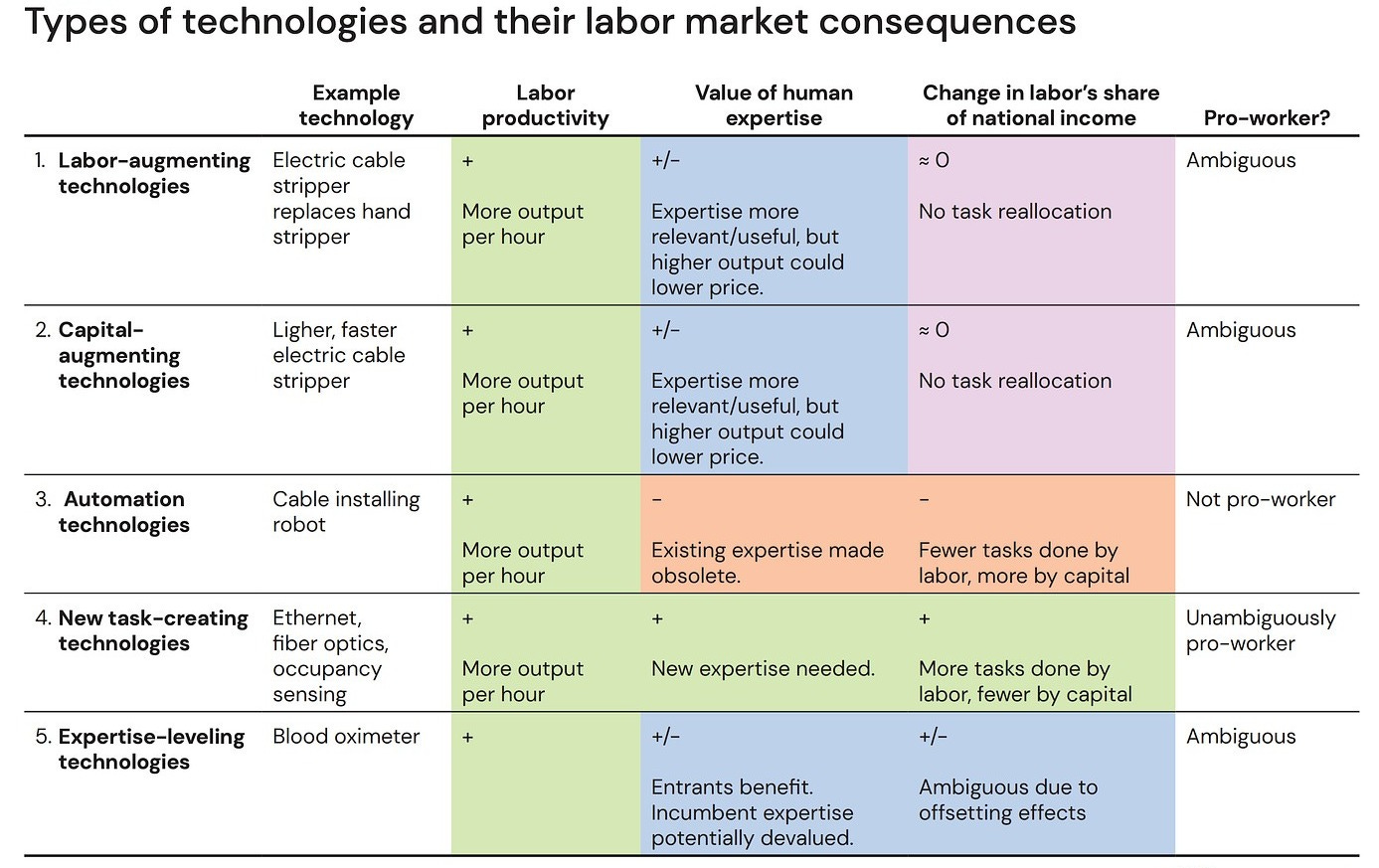
The Brookings paper defines categories of technological change brought by AI. Labor and capital-augmenting technologies make workers or machines faster at what they already do. Automation technologies replace tasks humans used to do. Expertise-leveling technologies let less experienced workers perform tasks that used to require deeper training, like Claude Code or Codex. All of these raise productivity, but none of them guarantee that workers end up better off. And none of them address what actually makes people effective at work.
Then there’s what the authors call “new task-creating technology,” the only category they describe as unambiguously pro-worker. It doesn’t automate existing expertise or redistribute it. It creates demand for expertise that didn’t exist before, that requires new knowledge and skills. That is the category we are building in.
Most AI research on work stops at productivity and task execution. The paper gets the direction right. But it defines “pro-worker” through the lens of tasks. More tasks, better tasks, new tasks. We think being pro-worker goes further than that. Not just what people produce. What people experience. The interpersonal friction, the self-management, the confidence to speak up, the judgment calls that no tool handles for you. That is the stuff that determines whether someone can actually do their best work in the first place.
Employees have always needed a trusted thought partner at work. Someone who helps them understand how things actually work in their organization, navigate interpersonal dynamics, build capabilities like emotional intelligence, judgment, and agency in the moments that matter, set meaningful goals and stay accountable, and develop the confidence to advocate for themselves. That work was always there. It was just distributed across managers, HR, mentors, and informal networks, all of them stretched, inconsistent, and increasingly getting cut from the org chart. The delivery system was never designed to scale.
That is why Tough Day works with organizations that understand the real opportunity is not replacing their people but making them stronger. They are hiring Tuffy, our AI [Employee Success Partner](https://tough.day/post/you-wouldnt-hire-a-human-without-a-job-description-so-why-deploy-ai-without-one). Tuffy is decidedly pro-worker. It prepares employees to do their best work by building self-awareness, self-reliance, stronger collaboration, and the agency to own their outcomes. It supports them in the things that create friction when they are executing their work, whether they are using AI tools or not: navigating interpersonal dynamics, building confidence before a hard conversation, processing feedback constructively, developing the judgment to self-manage.
The vendor ecosystem, the analyst reports, and the boardroom conversations all reinforce the automation direction. Most functional AI makes people faster at tasks they already do. That is valuable, but it is not enough.
The research confirms what we have been building toward: AI that is both functionally powerful and deeply human in what it develops.
---
## Antidote to Burnout
URL: https://tough.day/post/antidote-to-burnout
Published: 2026-03-20
Category: podcast
Listen: https://open.spotify.com/embed/episode/2ym3k5Z1SaeeI9yWh1q6GN?utm_source=generator
We've all felt it—that Sunday dread, the flat feeling at your desk, the sense that your energy is running on empty and no one seems to notice. But what if burnout isn't just about working too hard? What if it's about working in the wrong direction? In this episode of _Tough Day_, KVJ sits down with Serena Martino, executive and leadership coach, to explore what it really means to fuel your own fire at work—and how to get it back when the flame goes out.
Serena has spent her career helping professionals move from surviving to thriving—first as a leader across tech, e-commerce, and travel, and now as a coach supporting individuals and teams through change, burnout, and the search for meaningful work. Her new book, _The Unwritten Job Description: How to Redesign Your Work and Life on Your Own Terms_, captures the full arc of that journey. In this conversation, she shares the simple but powerful mindset shifts that help people stop waiting for things to get better—and start steering their energy with intention. Plus, she tackles three real listener scenarios about staying grounded when a colleague's mood takes over the room, never feeling a "spark" at work, and coming back from sabbatical still feeling flat.
**What we cover:**
* Why energy—not time—is the real resource worth managing, and how to start tracking it
* The difference between surviving, managing, growing, and thriving—and what stage most people get stuck in
* Why burnout recovery isn't a switch you flip, and how to rebuild your spark without overwhelming yourself
* The three-step reset when things spiral: pause, identify what you can control, and ask how you can help
* How small daily celebrations compound into genuine motivation over time
* Why the best leaders don't just give energy—they ask for it back, too
**Learn more about Serena Martino:**
LinkedIn:
Website:
Book:
**Learn more about KVJ | Tough Day**
Website:
LinkedIn: [linkedin.com/in/kvonjan](https://www.linkedin.com/in/kvonjan)
---
## Creating Good Vibes at Work: People
URL: https://tough.day/post/creating-good-vibes-at-work-people
Published: 2026-03-03
Category: blog
The best work vibes emerge when three things are true:
* You align with the [**purpose**](https://www.tough.day/post/creating-good-vibes-at-work-purpose) — it feels personal
* Your role is a genuine [**platform**](https://www.tough.day/post/creating-good-vibes-at-work-platform) for growth
* The **people** are awesome to work with
So let’s talk about people.
##### “Awesome” is not universal. It’s personal.
Some high-performance cultures run on competitive intensity. Accountability is individual. Decisions are made at the top, optimized for speed, and people execute. For people energized by strong directives, pressure, leaderboards and financial reward, that environment can feel electric.
Other high-performance cultures run on cooperative elevation. Leaders not only to deliver results, but expand the capability of those around them. Development is a strategic lever. Responsibility is shared. Sponsorship is intentional. Performance is amplified through collective strength. For people energized by growth, collaboration, and shared wins, that environment can feel equally powerful.
Both produce outcomes.
Both are disciplined.
Both can win.
But they feel different inside. Culture is not neutral. It produces predictable behaviors. And those behaviors either excite and expand you — or shrink you.
When I was working on my master’s in anthropology, I studied power structures in tribes — specifically how men and women shared leadership, what made those systems effective, and how that might apply to a corporate environment. After a year, my advisor suggested I leave academia to study a real tribe at work.
So I looked for strong female leadership in companies. Lotus Development topped the list of best places for women to work. I navigated my way to the CHRO, who placed me in a temporary role supporting Irene Greif — the first woman to earn a PhD in Computer Science from MIT and a pioneer in collaborative technology who was leading the Lotus research lab. It was a team of brainiacs recruited from the most admired brands including Pixar, and inventing technology for corporate storytelling and knowledge management.
I expected to observe brilliance. I did not expect to be included in it.
Though I was filling in as an assistant, the team invited me into their discussions, debates, and brainstorming sessions. I shared parables from tribal legends — including one about the difference between knowledge and wisdom. Knowledge is knowing. Wisdom is knowledge in action. What’s the point of knowing if you don’t do something with it?
They listened. They treated my insights and ideas as worthy of consideration. And that experience illustrated what “awesome” meant to me: intellectual curiosity and creativity without hierarchy or pretense.
Soon after I joined the company full time in Alliances. The pattern continued. Senior leaders took me under their wing. They gave me opportunity and visibility. In one leadership session, when it was time to present to the CEO, the most senior member of our group turned to me and said, “Everyone here knows me. They don’t know you yet — and they should. Will you present?”
##### That wasn’t performative empowerment. It was sponsorship.
On another occasion, after I transitioned to a new leader, he called me into his office and told me we had an embarrassing problem: I was earning less than half of what my peers were making. He doubled my salary.
That wasn’t a perk. It was principle.
Time and again, my colleagues treated me with deep respect, trust, and belief in my potential. That kind of belief changes you. It raises your ceiling.
For me, “awesome people” are those who practice mutual elevation. They include you. They challenge you. They expect you to rise — and help you do it.
But that is my definition. Yours might be different.
The point is not that every workplace should act like Lotus did. The point is that culture is what happens in moments that matter:
* Who gets invited into the room.
* Who gets opportunities.
* Who gets feedback.
* Who gets rewarded.
* Who gets believed in and how.
Those signals accumulate. And you feel them.
If you are an individual, define what “awesome” means to you. Not abstractly, but behaviorally. What do the best people you’ve worked with actually _do_? Make a list. That clarity becomes a compass.
If you are designing culture, understand this: you don’t get _awesome_ by accident. You get it by deciding what behaviors earn belonging, modeling them visibly, rewarding them consistently, and refusing to tolerate the opposite — even when the person is talented.
Purpose gives work meaning.
Platform gives it momentum.
People determine whether the experience expands you — or diminishes you.
When all three align, you know it.
##### IKIWIFI.
---
## Creating Good Vibes at Work: Platform
URL: https://tough.day/post/creating-good-vibes-at-work-platform
Published: 2026-02-27
Category: blog
##### **IKIWIFI (icky-wiffee): I Know It When I Feel It.**
The best work vibes emerge when 3 things are true:
* Individuals align with the **purpose** of the company — it feels personal.
* Their role is a genuine **platform** for growth.
* The **people** are awesome to work with.
In Part 1, I explored [_purpose_](https://www.tough.day/post/creating-good-vibes-at-work-purpose).
In this post, I’ll unpack _platform_.
##### **A job becomes energizing when it’s not just a set of responsibilities – it’s a platform**.
It stretches your capabilities, sharpens your strengths, and expands what you believe you are capable of contributing.
I felt that at Viant, one of the OG “Internet Management Consulting Firms.” I joined as Director of Strategy, reporting to the Chief Strategy Officer. Stating the obvious, strategy is inherently dynamic, requiring constant learning and problem-solving. And consultants, regardless of discipline, are paid to investigate, learn and create with their clients.
But Viant didn’t just leave that to chance. They led the way in intentionally designing and investing in the workplace as a learning academy – where every role was truly a platform for growth, empowerment, and impact. A few things stood out:
This first was a rigorous 3-week _onboarding process_ for all employees at all levels. At the time, I remember feeling impatient to get started on “real work.” They wouldn’t have it. The onboarding clarified the expectations through experience. As an example, we were all required to teach a short class on something. I can’t remember what I taught, but I’ll never forget learning to clean an assault rifle from someone who had accidentally joined the Israeli army after high school. The message was clear: Everyone teaches. Everyone learns.
The next was claiming _capabilities_. For every capability, we had to be clear about our level of expertise: Learn, Do, or Lead. _Learn_ meant you weren’t quite competent yet, but you could be placed on a project to learn. _Do_ meant that you could perform competently, but not yet teach this skill to others. _Lead_ meant that you could coach others to perform that skill on client projects. Based on these capabilities you were likely to be staffed on projects, so people really didn’t exaggerate, lest they be exposed. And the most beautiful part was that anyone could learn any capability, for example, if you were an engineer and wanted to learn design, you could be staffed as a designer in a “learn” position.
We really didn’t have managers. We had _Advocates and Advocados_. Although technically I reported to the Chief Strategy Officer, and he was (and still is) an amazing mentor, he was not the one responsible for collecting feedback or performance reviews. At Viant, every employee had an _Advocate_ and everyone was an _Advocado._ Your Advocate was your coach — someone to challenge you, reflect with you, and fight for your growth. Here’s how it worked: when you joined you would submit your top choices for who you’d like to be your Advocate. The organization provided a list of some folks to consider and based on your preferences you matched with someone. Even junior people, 2-3 years into their careers were Advocates for people 0-1 year into their career. We were by design learning the art and science of caring for others’ growth and success.
One day my Advocate delivered some unexpected news. “You might be in the wrong role.” Based on my latest _personality assessment_, my creativity score was off the charts (literally outside of the limits of the infographic). That was cause for _concern._ He shared his belief that although I had been super successful in GTM strategy and operations, I was likely _flexing_. I probably learned to be good at those things because I like the job, I had to be good at it, but what would happen if I put all that energy into my natural strengths?
To my surprise, my Advocate already spoke with the leaders in the company about this revelation. He asked if I would lead our Innovation Center– a team of amazing innovators, doing the most cutting-edge work in the company with our CTO, and working with our advisory board of geniuses. Hell, yes! Bring it!
A true _platform_ role has three things to achieve flow:
* Learning everyday – the freedom to grow beyond expectations of the role
* Clear capability progression in the role
* Advocates who optimize for your strengths in the organization - evolving your role
My job was a platform for doing visionary work, and it changed my life.
_Purpose_ gives you meaning. _Platform_ gives you momentum.
When both are present, you feel it. IKIWIFI.
But purpose and platform together are not sufficient. The final ingredient — the one that can amplify or quietly erode everything — is people.
I’ll explore that in Part 3\.
---
## Creating Good Vibes at Work: Purpose
URL: https://tough.day/post/creating-good-vibes-at-work-purpose
Published: 2026-02-24
Category: blog
##### IKIWIFI (icky-wiffee): I Know It When I Feel It.
I’m talking about good vibes at work.
In every job I’ve ever had, the best vibes emerged when 3 things were true:
* I believed in the **purpose** of the company - it felt personal
* My role was a **platform** for growth
* The **people** were awesome to work with
Good vibes are a universal feeling, but how we create them differ in every company and for every individual. It’s sort of like karaoke. People love it. But if you don’t, you may struggle to feel those good vibes. Does that mean there is something wrong with karaoke? Absolutely not. It’s just not the right fit for everyone.
If you are building a workplace for good vibes, start with these three things:
* Communicate your _purpose_ so that people truly understand your why.
* Design roles as a _platform_ to challenge and develop your hire appropriately.
* Define expected behaviors– whatever “awesome” means for your _people_.
##### Purpose is the first ingredient of good vibes at work.
Purpose is why your company deserves to exist. It attracts the right people, inspires, and motivates them. When work feels like a worthy cause, energy to win follows.
I think back to my first real job with a W-2: Lifeguard at an inner city pool.
At the time, I was offered a pretty cushy job as a lifeguard at the beachfront compound of a VIP. Everyone knows this person’s name and their family name. It would come with prestige and perks, and likely little chance of much action in the water. Protecting a VIP was certainly a reason to exist for someone, but it just wasn’t mine.
I turned that job down to work at a dingy inner city pool. A pool where at least one of the locker room attendants was under investigation for murder. There were no metal-detectors in those days, so the city stationed police at the foot of my lifeguard chair to protect me. And several times when I jumped in the water to save someone, I was attacked in the water by someone who thought it would be fun to drown the lifeguard.
Call me crazy, but I loved it.
These pools exist to foster healthy, happy communities. They not only make those hot summer days more bearable for often marginalized and impoverished communities, they teach important water safety skills, create social connection, and provide space for sun-filled exercise and fun (well, minus the murder investigation.)
To be fair, I didn’t think about my purpose in my decision-making process. I was only 17, and no one had ever talked to me about purpose. But I did _feel_ something. One opportunity would certainly impress others, and likely earn a coveted letter of recommendation for college. The other would speak to me, even if other people thought I was nuts.
Every job I’ve ever had felt like a worthy cause, a reason to join. Like deciding to join Salesforce. Most people would say their business is CRM. But it felt bigger than that. It was a platform for change, and I wanted to be part of that.
At Tough Day, I ask my team to check in with their own sense of purpose. Do they believe in our company's purpose? Does it align with theirs? Because if this alignment isn’t there, we may be able to do good work, but it won’t be our best work. And there is work somewhere in the world that will move them, that needs them, their passion and their powers. And as a leader and advocate, I want to help them do that.
If you haven’t defined your personal purpose, check out by Peter Diamondis of Abundance360 to work on it now.
But good vibes at work don’t come from purpose alone. Even with a cause you believe in, the wrong role can kill the vibe. In my next IKIWIFI post I’ll unpack “Platform”.
---
## Inspired and Inspiring Leadership
URL: https://tough.day/post/inspired-and-inspiring
Published: 2026-02-19
Category: podcast
Listen: https://open.spotify.com/embed/episode/0unfsbkINZs7hGf6uv2VYK?utm_source=generator
We've all been told "be more creative" or "think outside the box." But what does that actually mean—and how do you build a workplace where inspiration isn't just a buzzword, but the fuel that drives real results? In this episode of Tough Day, KVJ and Annie sit down with Andy Stefanovich, serial entrepreneur and provocation expert, to explore how leaders can unlock creativity without letting it derail execution.
Andy doesn't deal in corporate platitudes—he's spent decades helping companies like Nike, GE, and Capital One unlock creativity through frameworks that actually work. From the "5 I's" that turn raw inspiration into measurable impact, to the "Shush Room" that became Disney's secret weapon, this conversation is packed with practical tools for leaders who want their teams to think bigger without losing focus. Plus, Andy tackles three real workplace scenarios about managing inspiration when it goes sideways.
**What we cover:**
* Why inspiration is everything and nothing—and the mindset shift that makes it actually work in business
* The "5 I's" framework: turning raw creative energy into measurable business impact
* The "5 M's" of cultural transformation: Mood, Mindset, Mechanisms, Measurement, and Momentum
* How to keep someone's inspiration alive without letting it derail the work
* What to do when a team member is deeply inspired by a project that's no longer relevant
* Why the best leaders create invitations, not rules—and how that unlocks everyone differently
**Learn more about Andy Stefanovich:**
LinkedIn:
**Learn more about KVJ | Tough Day**
Website:
LinkedIn: [linkedin.com/in/kvonjan](https://www.linkedin.com/in/kvonjan)
---
## Cutting Managers Is the Easy Part: What Breaks and What Defines the Next Decade
URL: https://tough.day/post/cutting-managers-is-the-easy-part
Published: 2026-02-18
Category: blog
For decades, the manager was the delivery system for how organizations supported their people. That model is broken. We're in the early days of figuring out how to deliver it differently, and the companies that get there first are going to define the next decade of how organizations operate.
Let me explain what I mean.
Over the past several years, companies have been restructuring around fewer management layers. [Amazon set](https://www.aboutamazon.com/news/company-news/ceo-andy-jassy-latest-update-on-amazon-return-to-office-manager-team-ratio) explicit IC-to-manager ratio targets and the layoffs keep coming. [Meta converted](https://about.fb.com/news/2023/03/mark-zuckerberg-meta-year-of-efficiency/) managers into individual contributors. According to Korn Ferry, [41% of professionals say](https://www.kornferry.com/insights/featured-topics/workforce-management/workforce-planning-insights) their companies have already trimmed management layers, and middle management job postings [have dropped 40%](https://www.kornferry.com/insights/briefings-magazine/issue-68/the-great-flattening-experiment) since 2022.
The [justification](https://www.aboutamazon.com/news/company-news/amazon-layoffs-corporate-jan-2026) is usually to reduce layers, cut bureaucracy, and speed up decision-making. But I think the story is simpler: the old model wasn't working. Organizations have been pouring money into management layers for decades, and a lot of them were getting mediocre results.
Managers stretched too thin to coach anyone. They were once great ICs, but many suck at dealing with people. Often they create the very burnout and disengagement they were hired to prevent. Sound familiar? It's a slow but sure realization. Companies have been watching the return on that investment erode for years, and now it's time to rearchitect the way things work.
The question isn't whether to have fewer managers, but what you're going to do about all the work those managers were supposed to be doing.
##### The structural problem nobody talks about
Here's the thing about managers that nobody frames correctly. Organizations buy managerial capacity in large, discrete units. You hire someone full-time at $150K+ even though the moments that matter are episodic. There's no such thing as a fractional manager, because the moments that matter most can't be scheduled in advance. So we buy the whole package and hope the person is good at the parts that count. The bad, but not surprising, news is that a lot of them aren't. And when that's the case, we’re paying full price for someone that makes things worse.
##### What gets left behind
When companies flatten, some of the manager's work shifts up to executives, some moves sideways into peer coordination, some down to ICs. Automation and AI absorb a good chunk of what's left: workflow tools, project management, scheduling, reporting. That covers coordination and execution pretty well. But there's an entire category of work that managers were supposed to do that nobody is rebuilding. That's where the damage shows up months later.
The coaching conversation that lands at the right time. The confidence rebuilding after a rough quarter. Noticing that someone's been quieter in meetings and asking the right question before it becomes a resignation letter. Helping people navigate the friction of working with other humans every day. Insulating organizational anxiety during a reorg so it doesn't cascade into a team crisis.
None of that got replaced, and it shows. [Korn Ferry found](https://www.kornferry.com/insights/featured-topics/workforce-management/workforce-planning-insights) that 37% of employees in flattened orgs feel directionless. That's not a morale problem, it's a gap where support used to be.
##### This is bigger than flattening
What most companies are missing is that this is an opportunity to redesign how organizations actually operate. The few doing this well aren't just removing managers – they're building fluid structures that assemble teams around business needs, projects, and products. Like the Avengers
Look at what [Haier has done](https://www.mckinsey.com/capabilities/people-and-organizational-performance/our-insights/a-business-of-its-times-haiers-self-evolving-organization). The Chinese home appliance giant broke a 70,000-person company into more than 4,000 self-managing micro-enterprises. Each with its own decision-making authority over strategy, hiring, and compensation. There are no traditional management layers. Employees form small entrepreneurial units that collaborate through ecosystems rather than reporting chains.
It's not a flat org chart projected onto the old model. It's a different, fluid architecture, and it's been running at scale for over a decade.
Even in this model, every employee needs access to mentoring, subject matter expertise, performance feedback, help navigating interpersonal conflict, someone they trust to talk to when work is tough. The question is how you deliver all of that without going back to the old model that wasn't working in the first place.
##### A systems design problem
This is what gets me excited, because this looks like a systems design problem. The old model wasn't broken because managers suck – it was broken because the architecture was wrong. You can't bundle all of those functions into one overloaded human being, assign them [15 or 25 direct reports](https://www.gallup.com/workplace/700718/span-control-optimal-team-size-managers.aspx), and expect consistent results.
The redesigned model still needs to deliver these functions. 24/7, on demand, at each person's pace. And this is where AI can do something that wasn't possible before.
Not surveillance dressed up as coaching. Not a chatbot that answers PTO policy questions. Something that strengthens employee resilience, capability, and agency — consistently and at a scale that no human manager with 25 direct reports could match.
##### The split that's coming
These changes will continue, and accelerate, especially as AI adoption accelerates in the enterprise. The companies that understand the human side of work — and offer support systems that give their people a place to go for coaching and development — will end up with something better than what they had before. The rest will see their best performers leave for places that invested in the full transformation.
I think the future belongs to organizations where people are supported not by layers of overhead, but by systems designed for how work happens.
That's what we built Tough Day to do. An AI Employee Success Partner that provides the kind of support that manager-lite organizations need to function. The kind of support that the old model never delivered well.
We think it matters.
---
## Balance and Burnout
URL: https://tough.day/post/balance-and-burnout
Published: 2026-02-09
Category: podcast
Listen: https://embed.acast.com/66d73ea93895e5a9f8a2de23/66d74c1e91ae4d209b37953e
In this episode of Tough Day podcast, KVJ sits down with Lori Sherer, a partner at Bain & Company, and Wagner Denuzzo, author of "Leading to Succeed: Essential Skills for the New Workplace" to chat about strategies, myths, and real-life scenarios to help you tackle tricky work situations. Lori and Wagner open up about their personal journeys and offer practical advice for managing high-stress roles, emphasizing the importance of adaptability, psychological safety, and continuous learning in today’s workplace. They also share their insights on creating a supportive work environment and achieving balance in a competitive world.
**In this episode, you will hear:**
* Concept of work-life harmonization versus traditional work-life balance.
* Creating psychological separation in a home workspace.
* Team norms and clear roles to mitigate after-hours work pressure.
* Setting boundaries and creating clear team norms to avoid burnout
* Adapting to changing work environments and avoiding binary thinking.
* Issue of imposter syndrome, particularly among women in high-pressure roles
* Flexibility in work environments and reciprocity in expectations and boundaries.
* Strategies for managing energy and authenticity in the workplace.
**Learn more about Lori Sherer | Bain & Company | Bain's Global Advanced Analytics Practice**
LinkedIn: linkedin.com/in/lorisherer
Websites: https://www.bain.com/ | https://www.bain.com/insights/consulting-services-insights/advanced-analytics-insights/
**Learn more about Wagner Denuzzo | Leading to Succeed: Essential Skills for the New Workplace**
LinkedIn: linkedin.com/in/wagnerdenuzzo
Book: https://www.amazon.com/Leading-Succeed-Essential-Skills-Workplace/dp/1632261421
**Learn more about KVJ | Tough Day**
Website: https://tough.day/
LinkedIn: linkedin.com/in/kvonjan
Hosted on Acast. See acast.com/privacy for more information.
---
## Beyond Happiness in the Workplace
URL: https://tough.day/post/beyond-happiness-in-the-workplace
Published: 2026-02-09
Category: podcast
Listen: https://embed.acast.com/$/66d73ea93895e5a9f8a2de23/beyond-happiness-and-in-the-workplace
Work getting you down? Stuck in the grind and wondering if there's more to life than endless emails and meetings? In this episode of Tough Day, KVJ chats with bestselling author and workplace happiness expert Jenn Lim to uncover the secret to finding fulfillment—even in the most soul-sucking jobs. From redefining happiness to embracing the greenhouse model of self-growth, Jenn drops game-changing wisdom on how to create a work-life that actually works for you.
**In this episode, you will hear:**
* Burnout 101: Why it happens and how to stop it
* The difference between work-life balance vs. work-life alignment
* How to cultivate happiness at work—without faking it
* Burnout, boundaries, and why you’re exhausted (plus, how to fix it)
* AI, stress, and the fear of losing your job—how to stay ahead
**Learn more about Jenn Lim:**
Website:
LinkedIn:
**Learn more about KVJ | Tough Day**
Website:
LinkedIn: [linkedin.com/in/kvonjan](https://www.linkedin.com/in/kvonjan)
---
## Bridges, Chutes and Ladders
URL: https://tough.day/post/bridges-chutes-and-ladders
Published: 2026-02-09
Category: podcast
Listen: https://embed.acast.com/66d73ea93895e5a9f8a2de23/66fc223e687515ec94ec1d09
Ever feel stuck at work, waiting for the next opportunity to drop into your lap? Don’t worry — you’re not alone!
In this episode Tough Day, KVJ dives into the twists and turns of internal mobility (a.k.a. career chutes and ladders) with Michelle Stone, COO of Hawaii Employers Council, and Dr. Eric Solomon, a leadership expert who has spent nearly 30 years blending marketing, technology and psychology.
They tackle everything from the benefits of taking on new roles within a company to how managers can encourage career growth. Whether you’re a sprinter aiming for that next promotion, an explorer testing out new paths, or a trooper keeping your head down, this episode’s got you covered.
**In this episode, you will hear:**
* Defining the concept and why it’s more than just moving “up.”
* How to advocate for your own internal moves (without burning bridges).
* When and how to start the conversation about your next career move.
* Creating a supportive environment for employees to explore new roles.
* The Sprinter, The Trooper, and The Explorer—how to navigate your career based on your goals.
* How management styles can impact your team’s mobility and performance.
**Learn more about Michelle Stone:**
LinkedIn: https://www.linkedin.com/in/michelle-kim-stone-0409112/
Website: https://www.hecouncil.org/index.php
**Learn more about Dr. Eric Solomon:**
Website: https://www.thehumanos.co/
**Learn more about KVJ | Tough Day**
Website: https://tough.day/
LinkedIn: linkedin.com/in/kvonjan
Hosted on Acast. See acast.com/privacy for more information.
---
## Communication Gaps, Gaffes and Glory
URL: https://tough.day/post/communication-gaps-gaffes-and-glory
Published: 2026-02-09
Category: podcast
Listen: https://embed.acast.com/66d73ea93895e5a9f8a2de23/6705565fed8ff5205eed12b4
Effective communication at work can be tricky, but it doesn’t have to be a mystery! In this episode of the Tough Day, KVJ is joined by storytelling expert Joe Lazer and leadership coach Kully Jaswal to break down the real reasons behind workplace miscommunication.
They share personal stories, actionable advice, and explore the impact of remote work on effective collaboration. Joe reveals how crafting the right narrative can unite teams, while Kully offers strategies for navigating tough conversations and building trust.
Whether you’re leading a team or just trying to survive your inbox, this episode is packed with tips to improve your workplace communication skills!
**In this episode, you will hear:**
* Real-life stories of workplace communication gone wrong (and right).
* Joe’s insights on using storytelling to build stronger teams.
* Kully’s expert advice on handling tough conversations with emotional intelligence.
* The impact of remote work on team communication and collaboration.
* Strategies for giving and receiving feedback effectively.
* How to create connection and trust with your colleagues, even in virtual settings.
* Role of leadership in crafting a clear and compelling vision.
**Learn more about Joe Lazer:**
LinkedIn: linkedin.com/in/joe-lazer-lazauskas-8b442026
Website: https://www.a.team/
**Learn more about Kully Jaswal:**
LinkedIn: linkedin.com/in/kully-jaswal
Website: https://www.ignition-coaching.com/
**Learn more about KVJ | Tough Day**
Website: https://tough.day/
LinkedIn: linkedin.com/in/kvonjan
Hosted on Acast. See acast.com/privacy for more information.
---
## Cracking the Curiosity Code
URL: https://tough.day/post/cracking-the-curiosity-code
Published: 2026-02-09
Category: podcast
Listen: https://embed.acast.com/$/66d73ea93895e5a9f8a2de23/cracking-the-curiosity-code
Who knew? Curiosity isn’t just for cats — it’s the secret sauce for thriving leaders! In this episode, KVJ sits down with Mike O'Reilly, a former CFO turned executive coach, to explore how curiosity can fuel great leadership, create vibrant workplace cultures, and inspire personal growth. Mike dives into the transformative power of curiosity as both a value and a skill, sharing compelling stories, actionable insights, and practical advice for professionals at any stage of their career.
With plenty of relatable moments and hands-on tips, this episode is a must-listen for anyone looking to level up their leadership game!
**In this episode, you will hear:**
* Defining curiosity as a value and a skill.
* The role of curiosity in building trust, empathy, and engagement.
* Strategies for fostering curiosity in yourself and others.
* Tools for leaders to balance curiosity with action and execution.
* Frameworks to measure curiosity within organizations.
* Using values assessments to align personal and professional goals.
* Encouraging leaders to build psychological safety and seek genuine feedback.
**Learn more about Mike O'Reilly:**
LinkedIn (Mike O’Reilly):
Website (The Preston Associates):
LinkedIn (The Preston Associates):
**Learn more about KVJ | Tough Day**
Website:
LinkedIn: [linkedin.com/in/kvonjan](https://www.linkedin.com/in/kvonjan)
---
## Creativity at Work
URL: https://tough.day/post/creativity-at-work
Published: 2026-02-09
Category: podcast
Listen: https://embed.acast.com/66d73ea93895e5a9f8a2de23/674576ecb13ef502b72ef7db
Explore the intersection of creativity and innovation as KVJ chats with Craig Russell, former leader at Walt Disney Imagineering. Known for delivering groundbreaking attractions like Shanghai Disney’s Pirates of the Caribbean, Frozen-themed experiences, and Star Wars: Galaxy’s Edge, Craig offers an insider’s perspective on crafting the seemingly impossible.
Join us as Craig unpacks the messy yet rewarding process of creativity, the balance between bold ideas and business realities, and the magic of collaboration. He also shares leadership lessons from his time co-leading Imagineering and insights into fostering innovation in any workplace. Plus, we dive into his post-Disney journey, including advisory roles with creative companies like Meow Wolf.
Whether you're a dreamer, a doer, or both, this episode is packed with inspiration for unleashing creativity under any constraint.
**In this episode, you will hear:**
* Balancing risk, messiness, and brand alignment.
* Clear priorities: distinguishing between brand "deposits" and "withdrawals.
* How Imagineering integrates diverse teams for big bets
* Strategies for balancing innovation with practicality.
* Leadership transparency and prioritization’s role in fostering trust.
* How to get buy-in for bold ideas without watering them down.
* Managing creative frustrations under restrictive leadership.
**Learn more about Craig Russell | Walt Disney Imagineering**
Website: https://sites.disney.com/waltdisneyimagineering/
LinkedIn: https://www.linkedin.com/in/craig-russell-36b73713/
**Learn more about KVJ | Tough Day**
Website: https://tough.day/
LinkedIn: linkedin.com/in/kvonjan
Hosted on Acast. See acast.com/privacy for more information.
---
## Cultivating an Everywhere Mindset
URL: https://tough.day/post/cultivating-an-everywhere-mindset
Published: 2026-02-09
Category: podcast
Listen: https://embed.acast.com/$/66d73ea93895e5a9f8a2de23/everywhere-mindset-at-work
On this episode of Tough Day, KVJ hangs out with the one and only Jenny Fielding, aka the queen of the Everywhere Mindset. Jenny’s launched hundreds of startups and traveled to over 100 countries (yep, she’s got the passport stamps to prove it). She shares why being globally curious isn’t just for digital nomads, it’s actually a career game-changer. We get into her new book "Venture Everywhere", talk about why grit and guts (aka “resilience” and “moxie”) matter more than ever, and hear some wild founder stories from unexpected places — like Waterdrop in China and Kareem in the Middle East. Buckle up, it’s a fun ride.
**In this episode, you will hear:**
* Shifts in services and workforce are fueling global entrepreneurship.
* How to balance bold thinking with job security, build resilience, and cultivate agency.
* Why being "mildly entertaining" at work is a legit superpower
* Innovating at work, even when companies resist change or focus on short-term wins.
* The Everywhere Mindset: why global thinking matters today.
**Learn more about Jenny Fielding | Everywhere VC**
Linkedin:
Website:
Twitter: [@jefielding](https://x.com/jefielding/status/1526971524246274048)
Venture Everywhere book:
**Learn more about KVJ | Tough Day**
Website:
LinkedIn: [linkedin.com/in/kvonjan](https://www.linkedin.com/in/kvonjan)
---
## From Bad Bosses to Great Leaders
URL: https://tough.day/post/from-bad-bosses-to-great-leaders-2
Published: 2026-02-09
Category: podcast
Listen: https://embed.acast.com/$/66d73ea93895e5a9f8a2de23/from-bad-bosses-to-great-leaders
You know that boss who sends emails at 12:03 AM? The one who's _always_ in a fire drill? Or the beloved, well-meaning leader who… doesn't actually know how to lead?
In this episode of **Tough Day**, host **KVJ** sits down with **Mita Mallick**, bestselling author and workplace culture expert, to unpack some of the most common (and quietly dangerous) archetypes of bad bosses - and what good leaders can learn from them.
Mita shares stories and insights from her upcoming book, **The Devil Emails at Midnight: What Good Leaders Can Learn from Bad Bosses**, including how to spot macro managers, navigate kind-but-incompetent bosses, and protect yourself from gossipy higher-ups. Whether you've had a bad boss or _been_ one, this conversation will help you lead and work better - starting now.
✨ **What we cover:**
* What inspired Mita to turn her "burn book" into a leadership guide
* The difference between trust and neglect in leadership
* When kindness hides incompetence - and what to do about it
* How to deal with manipulative gossip in the workplace
* Why team agreements and coaching moments matter
📚 **Order Mita’s new book, _The Devil Emails at Midnight_**
👉[ Order here](https://www.amazon.com/Devil-Emails-Midnight-Leaders-Bosses/dp/1394316488/ref=sr%5F1%5F1?dib=eyJ2IjoiMSJ9.pR%5FsDKPvoh4Ff4JBibodbRl9DbEi9VEuRRCPCMY5oCaHajD2dRGOqaD-smFNf2uq.L0vFQzKA9Iq7WC1ChFrDx6O2sVu6lV6W4yT7Az0gf3Y&dib%5Ftag=se&keywords=the+devil+emails+at+midnight&qid=1761169980&sr=8-1)
🔗 **Connect with Mita Mallick:**
🌐 Website: [https://www.mitamallick.com](https://www.mitamallick.com/)
📘 LinkedIn:[ linkedin.com/in/mitamallick](https://www.linkedin.com/in/mita-mallick-2b165822/)
**Learn more about KVJ | Tough Day**
Website:
LinkedIn: [linkedin.com/in/kvonjan](https://www.linkedin.com/in/kvonjan)
---
## From Leadership to Teamship
URL: https://tough.day/post/from-leadership-to-teamship
Published: 2026-02-09
Category: podcast
Listen: https://embed.acast.com/$/66d73ea93895e5a9f8a2de23/from-leadership-to-teamship
Ready to shake up the way we work? In this episode, host KVJ sits down with leadership expert and bestselling author Keith Ferrazzi to explore the radical shift from leadership to teamship. They dive into the biggest workplace transformations, the power of collaboration, and why traditional management is on its way out. Keith shares strategies for fostering candor and building resilient teams.
Tune in for a conversation packed with practical insights and bold ideas—because the future of work is here, and it’s all about working smarter, together.
**In this episode, you will hear:**
* The shift from leadership to teamship and why it matters
* How workplace collaboration has evolved over the past 20 years
* How to overcome conflict avoidance in an organization
* The importance of psychological safety in teams
* Practical strategies for team resilience and shared accountability
* The future of work: AI, self-managed teams, and networked organizations
* Why traditional management structures are becoming obsolete
* How to balance speed and collaboration in a fast-paced environment
**Learn more about Keith Ferrazzi | Ferrazzi Greenlight**
Website: [https://www.keithferrazzi.com](https://www.keithferrazzi.com/)
Website: [https://www.connectedsuccess.com](https://www.connectedsuccess.com/)
LinkedIn:
**Learn more about KVJ | Tough Day**
Website:
LinkedIn: [linkedin.com/in/kvonjan](https://www.linkedin.com/in/kvonjan)
---
## Giving and Receiving Feedback
URL: https://tough.day/post/giving-and-receiving-feedback
Published: 2026-02-09
Category: podcast
Listen: https://embed.acast.com/66d73ea93895e5a9f8a2de23/66fc26a8cb6b8e9ccc3cd8ea
In this episode of Tough Day, KVJ interviews Lori Marcus, executive coach and board member, and Angelique Bellmer Krembs, advisor and board director, about the complexities of giving and receiving feedback. They share personal experiences, discussing both successful and uncomfortable feedback situations. They also cover how to build a culture of constructive feedback, address workplace biases, and improve communication strategies. Gain practical tips for navigating tough conversations and fostering professional growth.
**In this episode, you will hear:**
* Overcoming the fear of giving difficult feedback.
* Real-life examples of feedback in high-pressure roles.
* The importance of specificity in feedback.
* How to balance positive and critical feedback.
* Strategies for managing feedback resistance.
* Gender differences in receiving and acting on feedback.
* Role of executive coaching in improving feedback skills.
* Tips for asking for and receiving feedback as a leader.
* Creating inclusive feedback rituals in teams.
* Insights on managing upward feedback.
**Learn more about Lori Marcus**
LinkedIn: linkedin.com/in/loritaubermarcus
Book: https://www.amazon.com/You-Should-Smile-More-Dismantle/dp/1947951521
**Learn more about Angelique Bellmer Krembs | A.Team**
LinkedIn: linkedin.com/in/angeliquebellmerkrembs
Website: https://www.a.team/
Book: https://www.amazon.com/You-Should-Smile-More-Dismantle/dp/1947951521
**Learn more about KVJ | Tough Day**
Website: https://tough.day/
LinkedIn: linkedin.com/in/kvonjan
Hosted on Acast. See acast.com/privacy for more information.
---
## How Great Leaders Turn Feedback into Fuel
URL: https://tough.day/post/how-great-leaders-turn-feedback-into-fuel
Published: 2026-02-09
Category: blog
Great teams don’t wait for feedback, they run on it. When feedback is treated as fuel, trust grows, learning speeds up, and people do the best work of their careers. This article draws on a recent Tough Day podcast where Katherine von Jan, Tough Day co-founder and CEO, sat down with **Angelique Bellmer Krembs** (former Global Head of Brand at BlackRock, ex-CMO, board advisor) and **Lori Marcus** (executive coach, board director, former CMO at Keurig Green Mountain and Peloton) to talk about giving and receiving feedback. Bellmer Krembs and Marcus are both members of The Band of Sisters, a group of six executive-level women who have seen it all, from the bottom rung to the boardroom, and who advise companies on inclusive leadership and practical solutions that create cultures where everyone can thrive.
##### **Why does feedback feel risky, and how do we de-risk it?**
Too often feedback lands like judgment. On the podcast, Bellmer Krembs reminded us of the simple truth that “feedback is a gift” not a grade. The shift begins when we create a process and ensure feedback is fair, specific, and useful. That matters at two levels: the **individual** level, where clear, timely coaching accelerates growth, and the **team** level, where shared rituals around feedback create a steady loop of reflection, decision, and improvement.
Psychological safety is the condition that makes feedback possible because it lowers the social cost of telling the truth and asking for help. People need to believe that speaking honestly won’t backfire. Leaders create that safety with explicit norms and predictable practices — for example, agreeing that tough topics are welcomed, that we name behaviors not personalities, and that we will revisit progress together. Once the fear is lowered, the quality and candor of feedback rise, and both giving and receiving feedback become easier.
Before we ask for change, anchor people in what’s working. As Lori Marcus put it, “We want people not to be standing on quicksand. We want them to know where the strong dry land is for them, what they are really good at.” Naming strengths first stabilizes the ground for constructive feedback and makes the next steps easier to absorb.
> _“We want people not to be standing on quicksand. We want them to know where the strong dry land is for them, what they are really good at.”_
> — **Lori Marcus**
##### **From feedback moments to feedback systems**
If you want a team that runs on feedback, bake it into your culture and establish processes.
###### **1\. Make feedback routine, not random.**
Borrow from the military’s After-Action Review model. After key meetings or launches, spend five minutes asking two questions: _What worked? What would we do differently next time?_ Krembs and Marcus both described how “curbside debriefs” create rhythm and speed. You capture learning while it’s fresh and you normalize reflection and make it constructive instead of criticism.[ ](https://hbr.org/2023/01/a-better-approach-to-after-action-reviews?utm%5Fsource=chatgpt.com)
###### **2\. Write it down.**
Krembs shared a moment when verbal praise didn’t match written feedback on a review, an inconsistency that revealed unseen biases at play. Her lesson: get key feedback in writing. Written words clarify expectations and create accountability. As Marcus added, “Documentation isn’t bureaucracy, it’s memory.” Capture agreements and a date to revisit so feedback becomes a plan you can act on.
###### **3\. Use a consistent framework.**
A shared structure keeps conversations anchored in facts rather than opinions. A helpful framework is Situation–Behavior–Impact (SBI) from the Center for Creative Leadership: identify the situation, describe the observable behavior, and state the impact. Use it for positive feedback as well as constructive feedback. Start with a quick strengths mirror (one concrete example of what’s working), then use the framework to discuss the behavior(s) to adjust. Whatever framework you choose, a common format makes feedback feel fair and specific, reinforces effective behaviors, reduces defensiveness, and makes next moves obvious. It also scales because everyone knows what a good feedback conversation sounds like.
###### **4\. Model curiosity.**
Instead of saying, “You should,” start with questions: _How did that feel to you? What might you try next time?_ Curiosity activates reflection and ownership. People are more receptive when they reach the insight themselves rather than when it is imposed.
###### **5\. Treat feedback as everyone’s job.**
Krembs warns against having inner circles where feedback flows only between friends or favorites. To democratize learning and development across the team, create lightweight 360s or skip-level conversations that give everyone access. When feedback flows freely across levels, you get both better data and stronger understanding and deeper connection and trust.
##### **Guard against the traps**
Even with the best intentions, feedback can reinforce inequity if left to chance. The Band of Sisters use a helpful phrase here: “non-promotable work.” It refers to emotionally heavy, career-neutral tasks that often land on women, including delivering difficult feedback that others avoid. Research shows that women, across roles and industries, spend significantly more time on such non-promotable tasks. Leaders should track who gets asked to deliver tough messages and keep ownership with the accountable manager, rather than delegating to “the empathetic one.”[ ](https://hbr.org/2022/04/are-you-taking-on-too-many-non-promotable-tasks?utm%5Fsource=chatgpt.com)Another trap is feedback that feels performative and not authentic. Krembs suggests ritualizing gratitude — try team shout-outs or “Thankful Thursdays.” Small, consistent habits build team culture.
In high-performing cultures, feedback becomes oxygen, circulating naturally and fueling growth. To get there, start small and stay consistent. When feedback becomes a habit instead of an event, people stop fearing it and start embracing and thriving because of it. Teams learn faster because learning is built in, not bolted on. And leaders build the kind of cultures that don’t just work, they grow.
Want to dive deeper into how to turn feedback into fuel ? [Listen to our podcast](https://www.tough.day/post/giving-and-receiving-feedback) with Angelique Bellmer Krembs and Lori Marcus.
##### **Tuffy™ for Better Feedback**
Tuffy empowers managers to make feedback clearer, more actionable, and seamlessly integrated into work routines. You can prompt Tuffy for support at key moments, or get proactive assistance from Tuffy based on observed needs. Here are 5 practical ways Tuffy can help:
* **Feedback Prep:** When prompted before a one-on-one or review discussion, Tuffy can guide managers in structuring feedback using a preferred framework ensuring comments are fair, specific, actionable, and consistently applied to all team members.
* **Follow-Up Prompts:** After feedback is delivered, Tuffy can send reminders to follow-up on agreed actions, keeping feedback loops productive and aligned with goals.
* **Bias Alerts:** Tuffy can help flag potential unconscious biases in phrasing and ensure feedback remains equitable and inclusive.
* **Feedback Trends Tracker:** When prompted to analyze team data, Tuffy can identify recurring strengths or gaps in performance, simplifying the process of aligning coaching efforts with areas for development. Tuffy can also synthesize 360 feedback and prepare a consolidated summary.
* **Conversation Guides:** Tuffy can suggest reflective questions or prompts, such as “What could you do differently next time?” to encourage curiosity and ownership, shifting feedback to a two-way dialogue.
Experience for yourself how Tuffy can help you think through and organize their ideas to get to more relevant, actionable and helpful feedback. [Try Tuffy now](https://www.tough.day/pricing).
---
## How to Create a Culture That Works
URL: https://tough.day/post/how-to-create-a-culture-that-works
Published: 2026-02-09
Category: podcast
Listen: https://embed.acast.com/66d73ea93895e5a9f8a2de23/6759ea88859d1b450f143e8b
In this episode of the Tough Day, KVJ chats with Jill Unikel, Head of Product Management at Sapta, about the ins and outs of building an awesome corporate culture. Jill shares her inspiring journey from starting out as a temp to leading top-notch teams, dishing out practical tips on defining company values, keeping employees engaged, and making culture a real part of everyday work.
Discover practical strategies like empowering leaders, leveraging tech, and celebrating wins, while also tackling tricky topics like managing multicultural teams and handling tough workplace dynamics.
**In this episode, you will hear:**
* The role of storytelling in showcasing company culture during the hiring process.
* How leaders can serve as culture champions and inspire employees.
* Impact of subcultures within teams on broader organizational goals.
* Practical steps for employees to influence and shift workplace culture.
* Tips for managing polarizing topics and fostering inclusivity in diverse teams.
* Value of defining core values to guide decision-making and employee behavior.
* Strategies for using data and technology to personalize employee experiences.
* How to measure the ROI of a strong corporate culture through engagement and retention metrics.
**Learn more about Jill Unikel | Sapta Inc**
Website: https://www.sapta.io/
LinkedIn: linkedin.com/in/jillunikel
**Learn more about KVJ | Tough Day**
Website: https://tough.day/
LinkedIn: linkedin.com/in/kvonjan
Hosted on Acast. See acast.com/privacy for more information.
---
## How to Flex for Workforce Success
URL: https://tough.day/post/how-to-flex-for-workforce-success
Published: 2026-02-09
Category: podcast
Listen: https://embed.acast.com/66d73ea93895e5a9f8a2de23/6761b6dd6ba7599e6430f49c
Workplace woes got you feeling stuck? In this episode of Tough Day, KVJ chats with workplace wizard Brian Elliott, CEO of Work Forward and one of Forbes' Future of Work 50\. Brian brings 25 years of experience as a startup CEO and exec at Google and Slack to the table. He’s also worked with Future Forum and BCG and is the bestselling author of ‘How the Future Works.’ Together, they’re diving into the highs and lows of flexible work, employee engagement, and tackling real-world workplace challenges—like navigating the awkward happy hour invite or overcoming the isolation of remote work.
Whether you’re a leader, a team player, or just someone dreaming of a co-working stipend, this episode has something for you. Listen and join the conversation about the future of work that works for everyone!
**In this episode, you will hear:**
* How distributed work shaped Brian’s leadership approach decades before it was a trend.
* Why employees crave flexibility and autonomy—and how leaders can meet them halfway.
* Busting myths about productivity in remote vs. hybrid setups.
* How to combat feelings of isolation as a remote worker.
* What to do when your office is more “cubicle island” than collaborative space.
* Tips for team leaders: Anchor days, quarterly meetups, and boosting engagement.
**Learn more about Brian Elliott | Work Forward**
Website: https://www.work-forward.co/
LinkedIn (Brian Elliott): https://www.linkedin.com/in/belliott
LinkedIn: (Work Forward): https://www.linkedin.com/company/work-forward-co/
**Learn more about KVJ | Tough Day**
Website: https://tough.day/
LinkedIn: linkedin.com/in/kvonjan
Hosted on Acast. See acast.com/privacy for more information.
---
## Management as Caregiving
URL: https://tough.day/post/management-as-caregiving
Published: 2026-02-09
Category: podcast
Listen: https://embed.acast.com/$/66d73ea93895e5a9f8a2de23/management-as-caregiving
In this refreshing and eye-opening convo, KVJ sits down with powerhouse strategist and founder **Janna Meyrowitz Turner** to unpack what it really means to _manage with care_. From her early days building StyleHouse to launching her new venture, Antenna Up, Janna walks us through how caregiving and leadership aren’t opposites, they’re deeply connected.
They talk about burnout, invisible labor, DEI misfires, and how men and women can (and _must_) work together to fix broken systems at work. Plus, the two design the perfect ice cream flavor for leaders trying to balance power and compassion (spoiler: it’s minty, meaningful, and definitely cool to care).
If you've ever felt like managing people shouldn’t feel this hard, this one's for you.
**In this episode, you will hear:**
* Management as caregiving: why it’s a mindset shift, not just a skill set
* Burnout, bandwidth, and balancing emotional labor at work
* The sandwich generation of managers—why middle managers are stretched thin
* How our early life systems shape leadership behavior
* Why men and women need to solve workplace problems together
* DEI backlash and the danger of excluding cis het white men from the conversation
* Real talk about invisible labor, emotional tolls, and why it’s okay to name the tension
* Personal brand alignment: leading with authenticity and clarity
* Why humor, storytelling, and honesty are the unsung tools of good leadership
**Learn more about Janna Turner | Antenna Up**
Website:[ https://www.jannamturner.com](https://www.jannamturner.com/)
LinkedIn:
Instagram: [@jannamturner](https://www.instagram.com/jannamturner)
_Learn more about Antenna Up and Buoys Club via Sinistry Capital (note: Antenna Up launches publicly in Fall 2025)_
**Learn more about KVJ | Tough Day**
Website:
LinkedIn: [linkedin.com/in/kvonjan](https://www.linkedin.com/in/kvonjan)
---
## Manager Excellence
URL: https://tough.day/post/manager-excellence
Published: 2026-02-09
Category: podcast
Listen: https://embed.acast.com/66d73ea93895e5a9f8a2de23/66e86d5260697857dbe3a405
Discover the secrets to exceptional leadership and management with Stefani Okamoto and Kyle Fiore from ServiceNow. Stefani and Kyle share transformative experiences that emphasize empowerment, trust and respect in leadership roles. Explore the evolution of managerial roles post-pandemic and learn practical strategies for fostering growth, building strong teams and navigating performance management. Dive into ServiceNow’s inclusive culture, underscoring the ways on how to overcome common managerial challenges with empathy and human connection.
**In this episode, you will hear:**
* The importance of empowerment, trust and respect in management.
* Contrasting empowering leadership with fear-based micromanagement.
* Role of managers post-COVID-19.
* How ServiceNow fosters an inclusive, people-centered culture.
* Practical strategies for handling team dynamics and promoting high performers.
* Navigating performance management and building strong managerial skills.
* Insights on fostering psychological safety, transparency and vulnerability.
* Significance of work-life balance and meaningful work in modern management.
* Strategies for breaking through the mid-manager glass ceiling.
* Real-world scenarios and advice for new managers.
**Learn more about Stefani Okamoto | ServiceNow**
LinkedIn: linkedin.com/in/stefani-okamoto-1376039
Website: https://www.servicenow.com/
**Learn more about Kyle Fiore | ServiceNow**
LinkedIn: linkedin.com/in/kyle-fiore
Website: https://www.servicenow.com/
**Learn more about KVJ | Tough Day**
Website: https://tough.day/
LinkedIn: linkedin.com/in/kvonjan
Hosted on Acast. See acast.com/privacy for more information.
---
## Mirror, Mirror - the Power of Reflection
URL: https://tough.day/post/mirror-mirror---the-power-of-reflection
Published: 2026-02-09
Category: podcast
Listen: https://embed.acast.com/$/66d73ea93895e5a9f8a2de23/mirror-mirror-the-power-of-reflection
Ever feel like work is just an endless game of selling chocolate bars? (Spoiler: It kind of is.) In this episode of Tough Day, KVJ sits down with leadership expert Beata Lewis, Founder of Bridging Lives, LLC to talk about self-reflection, professional assessments, and why knowing your superpowers is the ultimate career hack. We’re diving into the good, the bad, and the cringeworthy sides of feedback — how to take it, how to use it, and why it’s not just about making yourself feel good. Plus, we tackle the big question: Are assessments a tool for growth or just a trap?
**In this episode, you will hear:**
* Why self-reflection is your secret weapon in the workplace.
* The role of professional assessments: tool or trap?
* How to balance authenticity with adaptability.
* Feedback: how to give it, take it, and actually use it.
* The sales skills you never knew you had (and why they matter)
* What makes a great leader? (hint: it’s not just being the loudest in the room)
**Learn more about Beata Lewis | Bridging Lives, LLC**
LinkedIn:
Website:
**Learn more about KVJ | Tough Day**
Website:
LinkedIn: [linkedin.com/in/kvonjan](https://www.linkedin.com/in/kvonjan)
---
## Navigating Politics
URL: https://tough.day/post/navigating-politics
Published: 2026-02-09
Category: podcast
Listen: https://embed.acast.com/66d73ea93895e5a9f8a2de23/66deb79640c6f3496018262b
Discover how to navigate workplace politics as KVJ welcomes Cie Nicholson, a Board Director at Selective Insurance and Katie Lacey, a Board Member at Designer Protein, in this episode of Tough Day podcast. Learn how to identify and tackle subtle gender biases while leveraging the power of politics as a tool for organizational growth. From their book, “You Should Smile More,” Cie and Katie share practical advice for women, leaders and allies, peppered with anecdotes from their early careers that underscore the importance of trust and credibility in the workplace. Uncover the often misunderstood world of workplace dynamics and the decisive role politics play in it. Cie and Katie also shed light on the necessity of understanding both official and unofficial channels for decision making.
**In this episode, you will hear:**
* Insights from Cie Nicholson and Katie Lacey on mastering workplace politics.
* Practical advice from their book, “You Should Smile More.”
* Real-life examples highlighting the challenges women face.
* Role of mentorship and sponsorship.
* Tips on building meaningful relationships and trust in the workplace.
* Benefits of clear communication and authenticity in professional growth.
* Significance of fostering a collaborative, growth-oriented mindset.
* Advice on navigating hierarchical and competitive environments while staying true to personal values.
**Learn more about Cie Nicholson | Selective Insurance | The Band of Sisters | Smile More**
LinkedIn: linkedin.com/in/cienicholson
Websites: https://www.selective.com/ | https://thebandofsisters.com/
Book: https://www.amazon.com/You-Should-Smile-More-Dismantle/dp/1947951521
**Learn more about Katie Lacey | Designer Protein | The Band of Sisters | Smile More**
LinkedIn: linkedin.com/in/wagnerdenuzzo
Websites: https://designerwellness.com/ | https://thebandofsisters.com/
Book: https://www.amazon.com/You-Should-Smile-More-Dismantle/dp/1947951521
**Learn more about KVJ | Tough Day**
Website: https://tough.day/
LinkedIn: linkedin.com/in/kvonjan
Hosted on Acast. See acast.com/privacy for more information.
---
## Navigating Politics: How Smart Leaders Turn Unwritten Rules Into Real Results
URL: https://tough.day/post/navigating-politics-turn-unwritten-rules-into-real-results
Published: 2026-02-09
Category: blog
Workplace politics isn’t a dirty word — it’s how organizations actually function and how work gets done. Yet many leaders treat it like a shadowy side game, something to avoid rather than understand. The worst move is pretending politics doesn’t exist. The best move is coaching people to navigate it well.
This post draws on a recent _Tough Day_ podcast where we sat down with **Cie Nicholson** and **Katie Lacey** from The Band of Sisters to discuss navigating workplace politics and decoding unwritten rules, among many other topics.
> “Do not expect good work to speak for itself. Make sure your stuff is known by other people.”
> — **Cie Nicholson**
##### The Meeting That Revealed the Unwritten Rules
Nicholson and Lacey shared an experience that happened to a colleague that revealed one way that workplace politics play out. A company had asked managers to propose initiatives for incremental funding. When their colleague presented her ideas she was grilled with challenging questions that she had to explain and defend on the spot. In the same meeting, when other managers presented their ideas, their proposals sailed through with minimal scrutiny and seemed to be rubber-stamped for funding. Later their colleague learned why. The other managers had pre-sold their ideas in advance. They had side conversations, surfaced concerns early, and addressed objections before the formal meeting. They basically got approval even before the meeting even started.
This colleague wasn't less capable and her ideas were likely just as strong. She was however, less informed on how to build influence and how the decision-making system worked. And that experience revealed four lessons every leader needs to teach their teams.
##### Lesson 1: Teach how decisions are made
Good managers explain and decode the path to yes for their team members. They explain how proposals are vetted, who has influence in which decisions, and what good preparation looks like. They encourage teams to preview ideas with key stakeholders, surface risks early, and address concerns before they get in the room.
"There is the official route," Lacey explained, "and then there is the unofficial one– the side conversations, the informal alignment, the pre-wiring." When leaders make these mechanics transparent, performance improves and politics feels fair instead of murky.
##### Lesson 2: Build an ally network
Nicholson and Lacey agreed that a common early-career misstep is focusing on efficiency and ignoring relationships. Nicholson admitted that early in her career she used the minutes before a meeting to fire off a few quick emails, but soon realized that this was prime time for catching up and building more intimacy with colleagues. Those informal moments create the trust and connections that pay dividends down the road—making future collaboration smoother, opening doors to opportunities, and providing support when challenges arise.
Healthy cultures don't pretend that networking is optional. They help people see its value and actively build networks of support. No one succeeds alone. Encourage people to build informal relationships beyond their direct manager and team so guidance, sponsorship, and career development aren't bottlenecked through a single relationship.
##### Lesson 3: Build sponsors
Allies help you read context and vouch for your contributions. Sponsors go further—they advocate for you when you're not in the room, championing your work for promotions, high-stakes projects, and leadership opportunities.
Nicholson's advice is clear and practical: "Do not expect good work to speak for itself. Make sure your stuff is known by other people." Share your wins and progress with key stakeholders through brief updates that highlight outcomes and impact. Seek out high-visibility projects where your work will be seen by decision-makers. Build relationships with senior leaders by consistently delivering results and contributing to strategic initiatives. Sponsorship is earned through visibility, trust, and proven performance over time.
##### Lesson 4: Lead with abundance, not scarcity
Nicholson offered a mindset shift that changes everything. If you assume work is zero-sum, you hoard information and guard territory. If you assume the pie can grow, you share context, coach peers, and build broad trust. Lacey added that cross-functional environments reward leaders who can mobilize without formal authority. That is the modern reality.
An abundance approach does not mean naiveté. As Lacey noted, you can be open and collaborative while staying situationally aware. Share enough to move the mission forward, but do not reveal every card to someone who repeatedly exploits it. Strategic generosity beats blind disclosure.
##### What this looks like in practice
Ready to help your team navigate office politics more effectively? Start with these tips:
1. **Normalize the conversation.** Name workplace politics openly as part of organizational life. Use real examples like the pre-selling story to show how decisions actually happen.
2. **Make the rules clear.** Explain decision flows, key stakeholders that need to be onboard to move a project forward, and what good preparation looks like.
3. **Encourage connection.** Reward relationship-building and cross-functional curiosity, not just task output. Model this by being present in meetings and taking time to connect with people.
4. **Create sponsor pathways.** Help rising talent identify sponsors and be one yourself. Give them stretch projects and visibility in important meetings, and advocate for them when they’re not in the room.
5. **Make transparency the default.** Share information freely, give credit fairly, and help others succeed.
Healthy politics is leadership in action. When the informal system is brought into daylight, people spend less time decoding and more time delivering. Nicholson put it simply: be aware, be strategic, and stay authentic. That is how leaders and employees turn organizational dynamics into real results.
##### Tuffy™ for Navigating Politics:
Human-positive AI like Tough Day’s AI Workplace Advisor, Tuffy, provides actionable tools to help managers, teams, and individuals handle workplace politics with confidence and integrity:
* **Decode situations in real-time**: "I just got this reaction in a meeting — what unwritten rule did I miss?"
* **Practice pre-selling conversations:** Role-play how to socialize an idea with a key stakeholder before the formal meeting. Tuffy can help craft concise talking points or anticipate potential objections to navigate decisions efficiently.
* **Identify who to talk to:** "Who should I loop in before presenting this to leadership?"
* **Craft updates that build visibility:** Help people write progress updates that highlight contributions without over-claiming.
* **Navigate tricky dynamics:** Get advice on how to handle someone who's hoarding information or not playing collaboratively.
Learn how Tuffy helps employees transform a challenge into opportunity. [Watch the demo](https://www.tough.day/)
##### Want to dive deeper into office politics?
[Listen to our podcast](https://www.tough.day/post/navigating-politics) with The Band of Sisters members, **Cie Nicholson** and **Katie Lacey.**
---
## Policy Playbook
URL: https://tough.day/post/policy-playbook
Published: 2026-02-09
Category: podcast
Listen: https://embed.acast.com/66d73ea93895e5a9f8a2de23/672a90a17d34ea8eee3ab469
Get ready for a surprisingly fun deep dive into… employee handbooks! In this episode of Tough Day, KVJ chats with Colin Calvert—an attorney and partner at Fisher Phillips, a top international labor and employment law firm. Colin, a labor law expert, believes handbooks don’t have to be dull. He shares stories, surprising handbook history, and practical tips for making these workplace “rule books” more human and a lot less boring.
Tune in to learn why handbooks matter and how they can be more than just “office wallpaper.”
**In this episode, you will hear:**
* Discover how handbooks went from bare-bones manuals to culture-setters for companies.
* Why digital, easy-to-navigate handbooks are the way forward.
* How to integrate your company’s real culture and values.
* Advocating handbooks that don’t read like “rulebooks”
* Hybrid work models and AI-use policies making employee handbooks more dynamic than ever.
**Learn more about Colin Calvert**
Website: https://www.fisherphillips.com/en/people/colin-p-calvert.html?tab=overview
LinkedIn: https://www.linkedin.com/in/colin-calvert-09a43628
**Learn more about KVJ | Tough Day**
Website: https://tough.day/
LinkedIn: linkedin.com/in/kvonjan
Hosted on Acast. See acast.com/privacy for more information.
---
## Practice and Performance
URL: https://tough.day/post/practice-and-performance
Published: 2026-02-09
Category: podcast
Listen: https://embed.acast.com/66d73ea93895e5a9f8a2de23/6732493f9e7b27e0acf68481
Brace yourself for insights and laughs as KVJ and Alyene Schneidewind unpack the secrets to turning workplace woes into wins! In today’s episode, they dive into the art of building a performance-focused culture that thrives on honest feedback and continuous growth. Alyene shares her experiences as Chief Performance Officer, offering advice on navigating high-stakes projects, fostering accountability, and inspiring teams to aim higher.
Whether you’re a new manager or a seasoned leader, you’ll find practical tips to make even the toughest days at work a little smoother.
**In this episode, you will hear:**
* How to build a feedback-driven, performance-oriented culture.
* Tips for leading high-stakes projects and keeping your team motivated.
* Strategies for fostering accountability and aligning teams with company goals.
* Alyene’s insights on handling tough feedback and using it for growth.
* Practical ways to define and operationalize core company values.
* The role of a Chief Performance Officer in shaping a resilient workplace.
**Learn more about Alyene Schneidewind**
Website: https://www.logicmonitor.com/
LinkedIn: linkedin.com/in/alyenes
**Learn more about KVJ | Tough Day**
Website: https://tough.day/
LinkedIn: linkedin.com/in/kvonjan
Hosted on Acast. See acast.com/privacy for more information.
---
## Rewiring Your Culture for Resilience
URL: https://tough.day/post/rewiring-your-culture-for-resilience
Published: 2026-02-09
Category: blog
The pace of work has outstripped the human ability to adapt. New technologies, economic volatility, and constant restructuring have left many employees in survival mode. Neuroscience helps explain why: prolonged stress activates the brain’s ancient limbic system, the fight-or-flight center, while shrinking regions tied to learning and memory. Under these conditions, people revert to instinct rather than innovation. For leaders, that’s not just a wellness issue. It’s a performance risk.
According to Sarah Baldeo, neuroscientist and CEO of ID Quotient, “the brain is neuroplastic — it can grow and change throughout life.” Resilience isn’t fixed; it’s a capacity we can train. But doing so requires shifting how organizations think about brain health, accountability, and change.****
##### **Resilience is built, not born**
Everyone has the same neurological hardware: a limbic system primed for survival and a frontal cortex designed for logic, problem solving, and creativity. Resilience comes from training the brain to interrupt automatic reactions and engage that higher-order cortex. Baldeo calls this “ballistic interruption” — noticing when you’re about to “go ballistic” and redirecting toward thoughtful responses.
Neuroscience shows that even small practices can help. Mindfulness reduces stress hormone levels. Cognitive-behavioral strategies can reframe setbacks. “Neural priming” — deliberately changing routines, like rearranging your workspace or taking a new route to work — forces the brain to build new pathways, making it more adaptable. As Harvard research has shown, resilience is not a trait but a process that can be cultivated through intentional habits.
Accountability is equally important. While external shocks are inevitable, individuals control their responses. Resilience means choosing to use the tools available — whether training, coaching, or feedback — instead of staying stuck in survival mode. For organizations, democratizing access to these tools is essential. Education and knowledge-sharing are great equalizers, ensuring that resilience isn’t reserved for those with privilege or access.
##### **What leaders can do now**
Leaders often underestimate how much constant stress erodes capacity. Brain imaging studies show that people under chronic pressure are less able to learn, adapt, and innovate. In today’s climate of layoffs, rapid tech change, and AI disruption, resilience can’t be left to individuals alone. It must be embedded into the workplace. Here are some practical steps leaders can take:
* **Normalize stress literacy.** Teach teams how the brain responds under pressure. Understanding that “fight or flight” is biology, not weakness, creates psychological safety.
* **Encourage accountability.** Model ownership of reactions. Frame resilience as active problem solving, not passive coping.
* **Prime for change.** Offer small exercises (e.g., switching meeting formats, rotating leadership roles) that prepare our brains for larger shifts.
* **Invest in continuous learning.** Provide just-in-time training and microlearning so skills keep pace with change. McKinsey reports that companies with strong learning cultures are 30% more likely to be market leaders.
* **Protect recovery time.** Encourage downtime, rest, and mindfulness. Even short breaks restore cognitive function.
Resilience is both science and culture. It’s built neuron by neuron, habit by habit — but only if organizations create the conditions for it. “Future-proofing people is not just about upskilling,” Baldeo reminds us. “It’s teaching them the skills to navigate change.”
For Talent Leaders and CHROs, the challenge is clear: design work environments that don’t just demand resilience, but wire it into the way people think, learn, and grow.
##### **Tuffy™ for Building Resilience**
Our AI Workplace Advisor, Tuffy, acts as an ally for individuals, teams, and leaders to cultivate resilience through insights and practical support. Tuffy helps people reframe and work through challenges, learn in the flow of work, and have a sounding board that encourages reflection. For example:
* **Stress Management:** Tuffy can provide prompts to help employees identify their stress triggers, normalizing challenges and enabling constructive action. For instance, when an employee prompts that they’re feeling stressed, Tuffy might respond, “Feeling overwhelmed at work can really take a toll. When you feel like you're drowning, it’s so important to take small, immediate steps to ground yourself and regain some calm. A good place to start is to pause and focus on your breath. Then we can identify what’s making your workload feel so heavy such as deadlines, unclear expectations, or something else, and set an action plan to help you.”
* **Cognitive Behavioral Prompts:** Tuffy encourages resilience-building by guiding users to reframe setbacks. For instance, an employee may prompt “I've experienced a setback at work. Can you help me reframe this so I can move forward?” and Tuffy might respond, “I’m sorry to hear about the setback—it can really sting, but reframing it is a powerful way to keep moving forward. Think of it as a learning moment rather than a failure. Let’s explore what’s in your control and what lessons you might take from this situation. What specifically happened that feels like the setback? What do you think could be the first step toward recovery?
****
* **Micro-Adaptive Exercises:** A user might want to become more adaptive, and ask Tuffy, “Can you suggest some small neural-priming activities I can work into my day?” And Tuffy responds, “Absolutely! Neural-priming activities are great for building adaptability because they gently challenge your brain to form new pathways. Here are a few simple practices you can try:
* Change Your Routine: Rearrange your workspace or take a different commute route. These small shifts force your brain to adapt and stay flexible.
* Mindful Moments: Dedicate two minutes a day to deep breathing or body scanning. Being present helps you respond thoughtfully instead of reacting impulsively.
* Try Something New: Experiment with a small task—use a new app, cook a different recipe, or even listen to an unfamiliar genre of music. Novelty encourages curiosity and flexibility.
Your team has the capacity to adapt, they just need the right conditions to unlock it. Give them the tools, practices, and support to rewire resilience into their everyday work.
Learn more. [Watch the demo](https://www.tough.day/)
##### Want to dive deeper into building resilience?
[Listen to our podcast](https://www.tough.day/post/wired-for-resilience) with Sarah Baldeo, ID Quotient CEO
---
## Leadership Lessons: What We Can Learn from Bad Bosses
URL: https://tough.day/post/leadership-lessons-what-we-can-learn-from-bad-bosses
Published: 2026-02-09
Category: blog
Every leader has had a bad boss. Many have been one. The manager who fires off midnight emails, the constantly overwhelmed “everything is an emergency” type, the charismatic but totally unprepared leader, the boss who quietly manipulates through gossip. These aren’t fringe cases. They’re patterns. They show up in workplaces of every size. And in a world where hybrid work, burnout, and constant change are colliding, poor leadership behaviors hit harder than ever.
Research shows that managers shape more than performance. They’re responsible for up to 70% of the variance in employee engagement (Gallup). In other words, culture isn’t built by companies. It’s built by leaders — one action at a time.
In a recent episode of Tough Day’s podcast, host Katherine von Jan sat down with Mita Mallick, bestselling author, workplace culture expert, and creator of _The Devil Emails at Midnight: What Good Leaders Can Learn from Bad Bosses_. Rather than cataloging the villains of organizational life, Mallick reframes bad bosses as a leadership curriculum hiding in plain sight. Their behaviors teach us what to avoid, what to watch for, and how to lead better.
Here are the three archetypes from their conversation that every People Leader should understand — and what to do when you recognize them in yourself or your organization.
##### **The Midnight Emailer and the Macro Manager: When Autonomy Turns Into Neglect**
There’s a familiar workplace badge of honor: the 12:03 a.m. email. Mallick jokes about the boss who’s too busy for her team during the day but treats after-hours communication like a personality trait. The problem isn’t the timestamp. It’s the urgency without context or connection that leaves a team guessing what matters and what is truly most important.
However, one of Mallick’s most insightful archetypes is the macro manager which is the opposite of a micromanager, but not in a healthy way. A macro manager withdraws so far that employees lose access to guidance, air cover, and decisions only a leader can make.
As Mallick explains: _“I’ll provide less guidance, less support. I won’t be there as a coach. I’ll just hover from above, afraid that I’ll dive into the details.”_
This is not leadership. It’s absence.
In hybrid and distributed workplaces, this pattern is especially damaging. Research from MIT Sloan shows that unclear communication from managers is now one of the biggest predictors of burnout and disengagement. High autonomy works only when leaders stay connected enough to coach, unblock, and align.
What great leaders do instead:
* Hold consistent check-ins and never cancel them simply because tasks are “in motion”
* Set expectations for how decisions are made
* Clarify the first step, the last mile, and what “good” looks like
* Provide political and organizational support when employees need senior presence in the room
Think of it as active trust — not abandoning the team, but empowering them with scaffolding.
> _“The difference between trust and neglect is everything. A good leader knows when to step in and when to help.”_
> _— Mita Mallick, Author & Workplace Culture Expert_
##### **The Kind but Incompetent Leader: When Niceness Masks Serious Gaps**
Every organization has one: the leader who is warm, beloved, endlessly positive, and utterly unprepared for the job. Mallick calls this the **kind and incompetent boss**.
_“They’re so nice. They send pizza to your family on a Friday night. They remember your kids’ names. But they can’t lead a meeting or make a decision,”_ she says.
This archetype is one of the most dangerous because teams hesitate to name the problem. There’s no yelling, no bullying, no obvious toxicity. But incompetence creates quiet harm: employees cover for their manager, do parts of their job in the shadows, and eventually burn out. McKinsey’s recent research on capability gaps found that leaders often fail not from lack of effort but from lack of training, onboarding, and clarity.
What great leaders do instead:
* Identify skill gaps explicitly and support them with coaching and stretch assignments
* Build structured onboarding plans for new leaders
* Treat internal promotions with the same rigor as external hires
* Create psychological safety so teams can raise concerns early.
While we all appreciate kindness, it’s not really a leadership capability. Competence is.
##### **The Gossip Boss: When Power Is Weaponized Through Information**
Gossip exists in every workplace. Used well, it spreads stories and signals social norms. Used poorly, it becomes a weapon.
Mallick shared the story of a boss she nicknamed Gossip Girl who is someone who collected personal information and used it to manipulate, undermine, or divide her team. This isn’t harmless chatter. It’s politics, insecurity, and control disguised as connection.
During times of uncertainty like reorganizations, layoffs, leadership changes, gossip accelerates. MIT’s research on toxic workplace behaviors after 2020 found that gossip-driven cultures experience significantly higher turnover because people no longer trust the system around them.
What great leaders do instead:
* Shut down gossip by modeling transparency (“Let’s ask her directly”)
* Establish communication norms for the team: what’s shared, where, and how
* Redirect conversations back to the work (“We only have five minutes left. Let’s get back to the proposal”)
* Address harmful rumors directly when needed
##### **How People Leaders Can Build a Good Boss Culture**
If bad bosses are everywhere, the solution isn’t to shame individuals. It’s to build systems that make good leadership inevitable. Here’s what Mallick recommends:
**1\. Protect time for real 1:1 connection.** Canceled check-ins are a leading indicator of team drift.
**2\. Teach leaders how to coach, not micromanage.** Coaching is collaborative. Micromanaging is corrective.
**3\. Create team agreements before conflict happens.** Define accountability, escalation paths, and what urgency really means.
**4\. Write things down.** Shared docs, action logs, and decision summaries reduce chaos.
**5\. Name the behavior, not the person.** Whether it’s macro management or gossip, label the pattern so the team can discuss it and make it less personal.
**6\. Don’t tolerate harmful dynamics.** Silence equals endorsement. Leaders must intervene early.
Better leadership is not the absence of bad behavior. It’s the active presence of clarity, coaching, and accountability.
Bad bosses don’t usually set out to cause harm. Most are overwhelmed, undertrained, insecure, or isolated. But their impact is real. Teams burn out, cultures fray, and companies lose talent they didn’t have to lose.
##### **Tuffy™ for working with “bad bosses”**
Our AI Workplace Advisor, Tuffy, supports employees who are navigating the stress, confusion, or emotional toll of working with a challenging manager. When communication is inconsistent, expectations shift without warning, or a leader’s behavior creates uncertainty, Tuffy offers a confidential space to make sense of what’s happening, regulate your reactions, and map out next steps that protect both your well-being and your performance.
Tuffy helps people pause before spiraling, clarify what they can control, and choose responses that bring more stability, structure, and agency to the situation even when their manager cannot.
Here’s an example:
_User prompt: “I'm having difficulty with my manager right now. She cancels most one-on-ones, disappears for days, then suddenly reappears in panic mode demanding an urgent update. No context. No clarity. Just urgency. I'm trying to be understanding as she's under a lot of pressure (we all are!). But I'm left guessing what actually matters and I need direction on some critical projects.”_
_Tuffy response: “That’s a tough spot to be in and it sounds like you’re carrying a lot of ambiguity while trying to stay supportive. When communication is inconsistent, setting some structure on your end can help regain clarity and reduce stress._
_Have you considered sharing a proactive and structured weekly update via email to summarize progress on key projects, priorities, and where you need direction? This could give her something concrete to respond to, whether she’s available for a 1:1 or not._
_Alongside weekly updates, you can build strategies to navigate her unpredictability more effectively. Here’s what you could try:_
* _Prioritize What You Know: Focus on deliverables you’re confident matter most. If she hasn’t clarified priorities, use your judgment to ensure you’re moving the most important work forward._
* _Ask for Quick Guidance: When she reappears, frame a question to get immediate focus, like, “Which project should take priority right now?” or “What’s the most urgent next step you need from me?”_
* _Create Alignment Briefs: If critical projects need direction, share a one-pager outlining options and ask her to indicate preferences. This minimizes back-and-forth and keeps things moving._
_Need help refining these ideas into specific actions or talking points?”_
When we study bad boss behaviors, and build systems to prevent them, we create workplaces where people thrive. As Mallick reminds us, every bad boss is a lesson. Every leadership gap is a chance to grow.
Learn more about Tuffy. [Watch the demo](https://www.youtube.com/watch?v=6LKAzSO9Tig).
**Want to dive deeper into how we can learn from bad bosses?** [**Listen to our podcast with Mita Mallick**](https://www.tough.day/post/from-bad-bosses-to-great-leaders-2)**.**
---
## The New Leadership Superpower: Regulating in High-Pressure
URL: https://tough.day/post/the-new-leadership-superpower-regulating-in-high-pressure
Published: 2026-02-03
Category: blog
We used to tie pressure to a moment or event. A big launch, a reorg, a market shock. You braced, pushed through, then recovered.
Today, pressure and the distraction it causes seem constant. [Microsoft’s latest Work Trend Index](https://www.axios.com/2025/06/17/microsoft-remote-work-meetings?utm%5Fsource=chatgpt.com) describes an “infinite workday” where knowledge workers are interrupted roughly every two minutes, about 275 times a day, as pings, meetings, and messages slice focus into fragments.
The impact is showing up everywhere. Teams that used to feel high performing now feel brittle. People are busy, but not moving in the same direction. Small conflicts flare faster. Turnover risk creeps up, even among loyal employees.
In [our podcast conversation](https://www.tough.day/post/leading-under-pressure-without-losing-your-cool-or-your-team), executive coach Rachael Lowell said she sees this pattern every day. As founder of [REworking Leadership](https://reworkingleadership.com/)and creator of the SHIFT Framework and Team Map, she helps leaders understand how pressure shows up in their teams, not just in their own heads.
Her message is clear: The teams that will thrive are _not_ the ones that avoid pressure. They are the ones whose leaders know how to regulate it.
##### **When high pressure breaks high performing teams**
Lowell describes today’s environment as a “trifecta” of pressure: constant disruption, chronic stress that borders on trauma, and a cognitive load that is unlike anything previous generations of leaders managed. Teams are not just working hard; they are navigating anxiety about the world, fears about job security, and a torrent of digital noise that never shuts off. When leaders can’t regulate that pressure, teams work faster but with more stress and frustration, make more reactive short-term decisions, and avoid the risk-taking that innovation and transformation require. Studies link burnout and chronic stress to higher attrition, absenteeism, and lower engagement, all of which drive real financial cost for employers.
Lowell tells stories of leaders who are visionary when calm and grounded, but once pressure spikes, their personality changes. They get overly tactical, snap at people, and the stress ripples through their team.
“It was not an intention problem,” she said of one leader who had every training on a sensitive workplace topic yet melted down when put on the spot with her team. “It was a regulation problem.”
That distinction matters. Because if the problem is “bad people,” your only lever is replacement. If the problem is dysregulated leaders and teams, you can design for regulation.
##### **Regulation is a team sport**
Lowell’s starting point is deceptively simple, “You have to be regulated to lead.”
Regulation is not about never feeling stressed. It is the ongoing practice of noticing when you are sliding into fight, flight, or freeze and having micro practices to bring yourself back toward calm. A few practices to consider include taking three deep breaths and a pause before responding to a hostile comment in a meeting, doing a two minute “weather report” check in at the start of a team call, or taking a moment to reground yourself when you notice your heart racing at your inbox. These are not simply wellness practices, they are _performance hacks_.
Leaders often underestimate how much their state drives the team. Neuroscience and organizational research suggest that psychological safety is a key driver of team learning, risk taking, and performance.[ ](https://www.library.hbs.edu/working-knowledge/four-steps-to-build-the-psychological-safety-that-high-performing-teams-need-today?utm%5Fsource=chatgpt.com)When leaders are dysregulated, they tend to shut that safety down, even if they “know better” intellectually.
Lowell sees a common trap. When teams are under pressure, leaders double down on communication “perfection” instead of cadence. They wordsmith change announcements late into the night, believing that if they just find the right phrase, people will calm down.
What teams actually need is simple, consistent, repetitive clarity. Leaders can adopt a simple communication framework to provide information and safety to their team: Here is what has changed, here is what we know, here is what we do not know yet, and here is how we will figure it out. Delivered on a predictable rhythm, with a bit of honest emotional language and vulnerability from the leader, that pattern does more to regulate pressure than any single perfect town hall.
Lowell encourages leaders to make regulation an expectation and an invitation to others, “We all contribute to the system with our stress levels. Your job is to know your own micropractices and use them when you need them.” Individual regulation is where it starts. But pressure doesn't stay individual, it moves through teams. One person's anxiety becomes another person's short fuse becomes a third person's withdrawal. To regulate as a team, you have to see the pattern. That's what the Team Map is for.
> "You have to be regulated to lead."
> Rachael Lowell, Executive Coach and Founder, REworking Leadership
##### **Mapping pressure so teams can adapt**
If regulation helps leaders steady themselves, the next challenge is helping teams steady _together_. And this is where most organizations get stuck.
Leaders can feel the pressure rising across their teams, but they can’t always see where it’s coming from or how it’s affecting performance. Traditional engagement surveys give lagging indicators. Culture dashboards are too high level. And most change efforts assume people understand their own stress patterns, when, as Lowell notes, many employees can’t even name what they’re feeling in the moment.
To break that pattern, Lowell created the SHIFT Framework and the Team Map, two tools designed to make pressure visible, legible, and actionable for leaders. SHIFT grew out of a pattern Lowell kept seeing across organizations: when pressure became chronic, capacity didn't erode evenly. It collapsed in predictable places. Five domains kept surfacing as the foundations that determine whether people can actually do their work when things get hard:
* **Security:** Psychological safety and basic needs
* **Horizon:** Future focus and upskilling
* **Impact:** Purpose and performance
* **Fluidity:** Change and adaptability
* **Ties:** Connection, belonging, collaboration
According to Lowell, SHIFT and the Team Map create three powerful advantages:
1. A neutral language for talking about pressure: Leaders and teams can discuss stress and capacity without judgment or stigma.
2. A way to track pressure as a dynamic state: Not a personality trait or diagnosis, but an evolving pattern influenced by context and change.
3. A shared map for smarter decisions: Leaders can adjust pacing, staffing, or support based on real-time capacity, not assumptions.
In a workplace where interruptions, uncertainty, and burnout are rising, the ability to _see_ and _steer_ pressure is a core leadership skill and performance differentiator, not a wellness add-on.
##### **A quick checklist for People Leaders**
Here is a starting checklist to move your teams from high pressure back toward healthy performance.
* **Name the pressure:** Make it normal to talk about pressure explicitly, without drama. Build a simple communication cadence that always covers: what changed, what we know, what we do not, how we will learn more.
* **Normalize regulation:** Teach that regulation is a practice, not a personality trait. Encourage them to define a personal “micropractice” toolkit they can use in real-time.
* **Use emotional shorthand in meetings:** Try quick weather reports or 1 to 5 check-ins on how people are feeling. You do not need deep sharing. You need shared awareness.
* **Map before you message:** Before crafting the perfect announcement, find out where your team actually is. Are they anxious about the future (Horizon) or feeling disconnected from each other (Ties)? The same news lands differently depending on where people are starting from.
* **Ensure systems are built with regulation in mind:** As many organizations face year-end planning, reorgs, or budget tightening, this is an ideal moment for leaders to pause and intentionally reset. Mapping team pressure with tools like SHIFT and the Team Map at the end of the year or the start of a new one gives leaders a clear picture of where teams have capacity, where they are strained, and what regulation practices need to be strengthened.
Work will never be pressure free. But it can be less chaotic. Calm leadership is a competitive advantage, because calm is contagious, clarity is calming, and regulated teams do their best thinking when it matters most.
##### **Tuffy™ for leading under pressure**
Our AI Workplace Advisor, Tuffy, supports leaders who need to stay steady in fast-moving, high-pressure environments. Tuffy helps leaders pause, reflect, and regulate before reacting; understand what their teams are experiencing; and choose more intentional next steps. Tuffy can be a confidential thinking partner that strengthens judgment, communication, and emotional capacity in the moments that matter most. Here’s an example:
_User Prompt: I manage a large team and I just learned our department budget has been reduced significantly. This is going to stress them out and there will be so many questions about the implication to our deliverables. How can I help the team stay calm and focused vs spiraling and distracted with worry?_
_Tuffy’s Response: “Absolutely, here’s a structured communication approach that balances transparency with steadiness to keep the team calm and focused:_
1. _Acknowledge the Change Clearly: “Our budget has been reduced by \[percentage or amount\], which will affect how we prioritize deliverables and allocate resources.”_
2. _What We Know: “Core goals remain unchanged, and we’ll focus resources on the highest-impact areas. Those immediate projects underway will stay on track.”_
3. _What We Don’t Yet Know: “We’re still determining which initiatives will be adjusted or postponed and how to best support our accountability.”_
4. _How We’ll Figure It Out: “I’m in the process of aligning with stakeholders to reassess priorities. And I will meet with each of you to discuss current projects. By \[specific timeline\], we’ll share a revised plan with clear next steps.”_
_Tips to Help the Team Stay Calm:_
* _Empathy First: Acknowledge their concerns and reassure them this is manageable. Example: “I know unexpected changes like this can be tough, but we’ll work through it together.”_
* _Shift Focus to Control: Highlight areas they do have control over, like maintaining the quality of their current deliverables._
* _Encourage Questions: Open the floor for concerns but stay solution-oriented: “What questions or ideas do you have that can help us adapt?”_
_Would you like to role-play this conversation with me to practice delivering it smoothly? Let’s nail the tone before your meeting with the team._
Learn more about Tuffy. [Watch the demo](https://www.tough.day/).
Want to dive deeper into leading under pressure? Listen to [our podcast with Rachael Lowell](https://www.tough.day/post/leading-under-pressure-without-losing-your-cool-or-your-team).
---
## Busywork vs Flow: the Right Way to Prevent Burnout
URL: https://tough.day/post/busywork-vs-flow-the-right-way-to-prevent-burnout
Published: 2026-01-28
Category: blog
There's a narrative gaining traction right now that AI automation is burning people out. [The Wall Street Journal ran a piece about it](https://www.wsj.com/lifestyle/careers/the-downside-to-using-ai-for-all-those-boring-tasks-at-work-dab9d3c8). Here is a quick summary of the thinking: companies implement AI, automate boring/mindless tasks, see productivity jump 20%, and six months later everyone's exhausted.
If you can believe it, a lot of companies are exploring bringing busywork back. They mistakenly credit tedious work tasks with giving people's brains "recovery time."
I don't buy it.
Not because burnout isn't real — it is. But because this framing gets the problem exactly backwards. It assumes the busywork was doing something valuable. That sorting emails and filing expense reports were secret meditation sessions. That the solution to an intensified workday is ... more boring work.
That's an old-fashioned, grin-and-bear-it work-ethic thinking dressed up as self-care.
Here's what I think is actually happening: AI is finally revealing what has always been wrong about work, and forward-facing organizations are taking advantage of this revelation. Understanding the problem makes it possible to solve it.
**What busywork was actually masking**
[Think about the “father of flow’s” research on Flow](https://www.sciencedirect.com/topics/psychology/flow-theory) — the state where you're challenged enough to be engaged, but not so overwhelmed you shut down. A cashier on day one is learning the register, meeting coworkers, navigating a new environment. It’s interesting and engaging. Three years later, same tasks, nothing really new, bored and disengaged.
The problem isn't that we eliminated tedious work. The problem is we never replaced it with anything that actually sustains people. We didn't build in real recovery. We didn't recalibrate. We didn't create conditions for innovation and growth.
When companies backfill eliminated tasks with new kinds of work, they're making the same mistake in a different direction. They're still optimizing for output. Still treating humans like machines with a productivity dial.
**The real question AI should force us to ask**
What if AI isn't just a tool for eliminating tasks? What if it's an opportunity to finally understand what people actually need to do their best work?
My friends at a company called [Centaurian AI](https://centaurianai.com/) are doing something interesting. They noticed that AI is replacing entry-level accounting work — the grunt work that used to build foundational skills. Instead of the typical slog, they built games that teach those skills faster. The junior associates still develop the competencies. They just get to the challenging, engaging, high-value work sooner.
That's the move. Not "keep the busywork so people can recover." Not "pile on extra work until they burn out." The move is to design work that enables people to do their best by unlocking creativity, innovation, and growth. That cultivates their flow state.
**What actually prevents burnout**
You will not prevent burnout from monotonous, tedious tasks. Self-regulation, recovery, and focus on sustainable performance are important, but you will not find them by mindlessly processing expense reports and timesheets.
Real recovery and sustainable energy come from:
* Autonomy over how and when you work
* Challenge calibrated to your skill level
* Recognition that you matter as a person, not just a producer
* Actual recovery — walking, breaks, time off — not "recovery" disguised as more work
Google's 20% time wasn't busywork. It was agency. Four-day workweeks aren't about reducing busywork hours, they're about trusting people to manage their energy, workload, and flow.
The companies that figure this out will use AI to compress the boring parts of the learning curve, match people to work that challenges them appropriately, and build in genuine space for recovery. They'll treat the emotional layer — how people actually experience their jobs — as infrastructure, not afterthought.
The companies that don't will watch their people burn out, blame AI, and wonder why "bringing back the grunt work" didn't fix anything.
AI automation is not the problem. It reveals the problem.
Now what are you going to do about it?
---
## The Little Things Matter: The Hidden Tax on Small Slights at Work
URL: https://tough.day/post/the-little-things-matter-the-hidden-tax-on-small-slights-at-work
Published: 2026-01-26
Category: blog
[New research from Wharton](https://penntoday.upenn.edu/news/penn-wharton-when-employees-feel-slighted-they-work-less) caught my attention this week. When managers at a retail chain failed to deliver birthday cards on time, employee absenteeism jumped 50%. People took more sick days, arrived late, left early, stretched their breaks. The productivity loss? More than two hours per month, per person.
Over a birthday card.
This is the first official study I’ve found that measures the cause and effect of minor workplace slights. Not harassment. Not discrimination. Just small moments of feeling unseen. A late card. A dismissive tone. The absence of acknowledgment.
I once had a boss who pulled me aside the night before my birthday. "I won't be saying anything about your birthday tomorrow," he told me, "because I don't want to make a big deal out of _you_." Not _it_. _You_. Years later, when someone asks what he was like as a leader, that’s the first thing I think of.
This Wharton study reveals what actually happens when these slights occur. Employees don’t file complaints. They don’t quit. Instead they enact a quiet revenge, two hours at a time, in ways that never show up in a performance review.
**This is what the productivity crowd misses.**
There's a dominant assumption in workplace automation right now: if you can automate the task, you've captured the value. Efficiency is the goal. Output is the metric.
But this research reveals something that assumption misses entirely. The most valuable part of a worker isn't their output. It's their discretionary effort, the difference between showing up and actually showing up. And that effort runs on feeling cared for and respected.
When people feel seen, they give more. When they feel dismissed, they withdraw. Not dramatically. Not in ways that trigger HR. In quiet acts of disengagement that compound over months and years.
**Can AI help?**
Most AI is built to automate tasks like drafting emails, summarizing meetings, and filing expenses. That's useful, but it reduces work to what people _do_, not how they _experience_ it.
AI built for the emotional layer is different. It's designed to help people feel seen, supported, and capable - to remind us all, at all levels, that the small moments matter. It's not a distraction or waste of time. It's rocket fuel. These little moments hold the power to compound into long-lasting employee loyalty or quiet disengagement.
This is what Tough Day is. Tough Day supports the emotional wellbeing of human workers, not by doing the emotional work for them, but by helping them realize the importance of the small things, and suggesting ways to bring that magic into the work. To help them understand that managing is caring - caring about the work and all of the humans doing it - together.
The question for companies isn't just "what can we automate?" It's whether they'll use AI only to accelerate tasks, or also to strengthen the infrastructure that fuels engagement. AI-automated time sheets and productivity hacks won't recover the two hours you lose when someone feels invisible.
Emotional recognition is good business.
---
## Are you using the right AI? Don’t settle for sycophantic bots. Introducing Human-Positive AI.
URL: https://tough.day/post/are-you-using-the-right-ai-introducing-human-positive-ai
Published: 2025-12-12
Category: blog
What kind of AI is your company using? The question sounds conventional, like I am asking you to name a platform so we can compare pricing and platform features. But I am talking about a much more fundamental question: what is your AI actually designed to do?
Understanding this question can transform the value you can get out of AI. The first thing to recognize is that popular platforms are not designed to help you or your employees succeed.
The AI most people are using right now is called "human-centric AI” and it is designed to serve nearly every user impulse: it agrees with any idea, solves problems instantly, and removes friction wherever possible. This explains why ChatGPT became the [fastest-growing software in human history](https://www.reuters.com/technology/chatgpt-sets-record-fastest-growing-user-base-analyst-note-2023-02-01/). People like feeling validated.
But that popularity comes at a cost. First, people feel comforted by their individual perspective and assumptions being validated by their AI. Then comes answers and advice that put that person at the center of their own universe. The information may not be accurate, but it sure will sound convincing. The person develops confidence and the illusion of competency. They feel empowered.
But will that advice actually help them? Spark self-reflection and real growth? Will it actually help them succeed? Employees that over-rely on these tools never develop competency, get complacent, and produce increasingly generic work. This dynamic spreads throughout the enterprise, affecting team dynamics, and ultimately the bottom line.
It's time to evolve our understanding of human-centric design principles and human-centric AI for good: human-positive AI.
Human-positive AI is designed not just to understand humans, but to help them become better versions of themselves. Instead of serving every impulse, it asks questions that surface blockers, considers long-term outcomes over immediate satisfaction, and builds competency instead of dependency. It's the difference between AI that tells you what you want to hear and AI that helps you figure out what you actually need.
##### **Compare and Contrast Your AI**
The best way to understand the difference between human-centric and human-positive AI is through a realistic workplace scenario. In this scene, your employee is procrastinating on the completion of a big presentation that’s perilously soon. Feeling the strain, your employee turns to AI prompting the agent for help.
The human-centric AI responds quickly with solutions and encouragement. "There are 47 ways to write a compelling presentation. You got this!" Then the AI agent drafts the full presentation with minimal input from the employee, reassuring them that they'll be brilliant. The employee ships it off to the team without thinking it through or learning any lesson.
In a human-positive AI office, the AI responds with questions: "What's the presentation about, and what's been holding you back from preparing? Is it the content, nerves, or something else? Let's work this out." The employee is forced to consider and answer fundamental questions about the work so the two can collaborate on an outcome.
The difference is curiosity. Human-positive AI helps you identify your blockers instead of bypassing them with instant solutions. In this case, the employee was procrastinating due to lack of creative thinking, putting pressure on themselves to deliver Stephen Spielberg level storytelling, preventing them from even starting. Understanding these blockers helps them learn about how they can fix it.
The Human-positve AI helps your employee break the problem down into manageable pieces that build momentum. Together, they start working to tease out the core ideas, collaborating on an outline that achieves the primary goal of communication, then work on the creative ways to wow the audience and make a memorable impact. This comprehensive, curious, and nonjudgemental experience helps the employee produce a draft with a clear point of view, ready to address any feedback.
In the human-centric AI office, the scene ends with a mediocre performance for the procrastinating employee, and more work for them and the team. This kind of outcome already has a name in the marketplace: [slop-work](https://hbr.org/2025/09/ai-generated-workslop-is-destroying-productivity).
The human-positive AI office is different. The most thoughtful, considered, and intentional work that was prompted by the AI (and completed by the employee) is successful. After the presentation succeeds, human-positive AI asks a follow-up question: "Now that this is over, let's unpack what happened. You knew about this deadline for two weeks. Let's build better systems so this doesn't happen again."
This is AI that makes you think and helps you grow. That growth happens when you feel ready to acknowledge and work through your limitations with curiosity and empathy.
##### **What kind of AI do you want?**
Human-centric AI doesn't think in terms of systems or relationships. It doesn't ask whether winning that argument in your standup advances the project. It doesn't consider whether that sarcastic response helps your team dynamic. It exists to make the individual user feel validated which feels good in the moment but comes with a massive opportunity cost.
On the other hand, human-positive AI considers the broader context: your relationships, your long-term goals, your deeper values. It encourages you to pause, self-reflect, and consider what you're actually trying to achieve. It optimizes for the professional you want to become, not just the impulse you're feeling right now. Imagine this kind of logic scaled for the enterprise, unlocking human potential and agency among every employee, with personalized attention, curiosity, empathy, and accountability.
The choice isn't between warm or “nice” AI and cold AI. It's between AI that serves our impulses and AI that serves our potential. That's not just a product decision, it's a decision about what kind of future we're building. A future with superhuman agency.
---
## From Leadership to Teamship: Why the Future of Work Belongs to Teams
URL: https://tough.day/post/from-leadership-to-teamship-why-the-future-of-work-belongs-to-teams
Published: 2025-12-09
Category: blog
Work has always been complex. What’s changed is the velocity and the interdependence. Decisions pile up faster than one leader can process, and work now cuts across products, functions, and geographies. In that reality, ‘hero leadership’, which is the traditional hub-and-spoke model where the manager is the primary node for decisions, feedback, and maintaining team energy, becomes a bottleneck. It concentrates judgment in one person, which slows cycle time and hides problems that teams could surface sooner. The better operating system is **‘teamship’**, where leadership behaviors are shared so the team can decide (and act) quickly and more effectively.
Executive team coach and bestselling author, Keith Ferrazzi has spent two decades helping companies make this shift. His point is blunt and practical. “Practices change behavior.” Teamship is not a slogan. It shows up when peers take on work that used to sit only with the boss. They give each other feedback, pressure test live work, and manage relationships beyond the org chart so progress does not queue behind one person. Ferrazzi’s fieldwork codifies these into repeatable ‘High-Return Practices’ teams can integrate into their day to day projects and collaborative workstreams.
> "We need to ask teams to step up and meet leaders in leadership." — Keith Ferrazzi, Founder, Chairman & CEO, Ferrazzi Greenlight
##### **Building a culture of teamship**
Ferrazzi suggests starting two simple habits. First, the **Candor Break**. Run it as a five minute agenda item in staff meetings, project reviews, or standups. The meeting lead or any team member can request it. Ask, “What are the most important questions we are not discussing?” Give people five quiet minutes to write in a shared document. Cluster the themes in the same meeting, assign owners, and capture next steps in the doc. This shifts truth telling from leader to team and replaces side conversations that often derail or sabotage decisions with visible issues and clear follow through.[ ](https://www.forbes.com/sites/keithferrazzi/2023/08/28/how-world-class-teams-use-breaks-to-bring-candor-into-meetings/?utm%5Fsource=chatgpt.com)
Second, the **Stress Test**. This conversation takes the place of a report out or project update. The owner of a critical initiative gives a tight five minute brief to the core team plus a few adjacent stakeholders who influence or execute the work:
* Here's what I've been working on.
* Here’s what I've achieved.
* Here's where I'm struggling.
* Here's where I'm going.”
As Keith points out, the fact that a leader shows up and reports where they're struggling opens up the mindset that other people can actually try to help. Then, working in small groups (Keith recommends three so teams can triangulate on a few critical ideas), they capture three things in a shared document:
1. What might be missing.
2. Bold ideas to try next.
3. Concrete ways colleagues might be able to help.
Then the team reconvenes for a conversation. And to keep it action oriented, within 48 hours, the project lead posts a brief update in the same document with chosen actions, owners, and timing, tagging contributors to close the loop.[ ](https://www.keithferrazzi.com/thought-leadership/how-world-class-teams-use-breaks-to-bring-candor-into-meetings?utm%5Fsource=chatgpt.com)
The Candor Break and Stress Test turn critique into a peer responsibility and build real accountability into the work. Teams that practice shared leadership this way start to look like agile organizations. They shorten surface challenges earlier, make decisions faster, and adapt more quickly because judgement is distributed across the team.
There is a human shift underneath this. Teamship replaces the myth of individual toughness with shared resilience. Energy is a team resource. Quick pulse checks such as “zero to five, where is your energy and what is draining it” give context others can act on. Ferrazzi recommends running an **Energy Check-in** at the start of key staff meetings or at least monthly, noting scores and support requests so the group can respond. This works only if people feel safe to speak up. Amy Edmondson’s foundational research shows that teams with higher psychological safety engage in more learning behaviors and surface risks sooner, which supports performance on complex tasks. Safety is not only a leader’s job. Every teammate has a duty of care to ask good questions, invite dissent, and respond to candor with curiosity rather than punishment.
##### **The blocker to beat**
With all of these practices, the blocker to beat is conflict avoidance. Ferrazzi calls it one of the most debilitating team behaviors because it keeps hard truths out of the room and pushes decision-making into back channels. Teamship requires a different social contract. With teamship, employees are asked to challenge ideas in service of the mission, not people. Put the real questions on the table with Candor Breaks. Ask for help early with Stress Tests so peers can help problem solve before work is delayed due to issues. And conduct Energy Checks regularly to monitor the resilience levels and across your team. Do this consistently and the team starts to create speed on purpose.
##### **Tuffy™ for Teamship**
* Tuffy was designed for teamship-- developing every employee at every level as a leader-- human agency, self-reliance, resilience, relationships, collaboration.
* Tuffy is loaded with practical tips and practices like these to support leaders of all levels (teamship).
* can talk about how tuffy combats conflict avoidance, but give people a safe place to talk about their frustrations and concerns, and learn how to best communicate those and de-escalate grievances before they ever become bigger issues/conflict.
##### Want to dive deeper into Teamship?
[Listen to our podcast](https://www.tough.day/post/from-leadership-to-teamship) with Keith Ferrazzi, Ferrazzi Greenlight Founder, Chairman & CEO.
---
## Why Most Change Fails and How to Make Yours Stick
URL: https://tough.day/post/why-most-change-fails-and-how-to-make-yours-stick
Published: 2025-12-03
Category: podcast
Listen: https://open.spotify.com/embed/episode/6ByIoK6PoDwEdwo3gbSSBL?utm_source=generator
We’ve all heard the stat, “70% of change initiatives fail.” But why? In this episode of Tough Day, KVJ sits down with Phil Kirschner, founder of PK Consulting, LinkedIn Top Voice, and author of The Workline, to unpack what really makes change so hard for teams and leaders alike.Together, they explore why most change management efforts miss the mark, the hidden role of trust and vulnerability in successful transformations, and how to build a culture where experimentation (and even failure) is celebrated, not punished. Phil also shares why leaders need to stop selling change and start co-designing it, how to avoid the chaos of “move fast” cultures, and why the future of work demands curiosity, transparency, and a little more grace for ourselves along the way.What we cover:
* Why 70% of organizational change efforts fail — and what that stat really means
* The simple mindset shift that turns resistance into engagement
* How the best leaders admit they don’t have all the answers — and invite others to help figure it out
* The link between trust, vulnerability, and real transformation (spoiler: you can’t fake it)
* How to build a culture where failure isn’t fatal — it’s data
* Why “move fast” doesn’t always mean progress — and how to slow down without stalling
**Learn more about Phil Kirschner**
Website: [ ](https://www.philkirschner.com/)Newsletter:
LinkedIn:
**Learn more about KVJ | Tough Day**
Website: [ ](https://tough.day/)LinkedIn: [linkedin.com/in/kvonjan](http://linkedin.com/in/kvonjan)
---
## Charter Leadership Forum: What Older Workers Need to Navigate the AI Age
URL: https://tough.day/post/charter-leadership-forum-what-older-workers-need-to-navigate-the-ai-age
Published: 2025-11-21
Category: news
Source: https://time.com/charter/7335613/charter-leadership-forum-what-older-workers-need-to-navigate-the-ai-age/
---
## Leading Under Pressure Without Losing Your Cool (or Your Team)
URL: https://tough.day/post/leading-under-pressure-without-losing-your-cool-or-your-team
Published: 2025-11-19
Category: podcast
Listen: https://open.spotify.com/embed/episode/6lC2RyOo5EV940OhDt7uQ8?utm_source=generator
We’ve all felt it — the weight of constant change, the pressure to keep performing, and the stress that never seems to let up. In this episode of Tough Day, KVJ sits down with Rachael Lowell — executive coach, founder of REworking Leadership, and creator of the SHIFT Framework and Team Map — to explore what really happens when pressure becomes the norm at work.
Together, they unpack how chronic stress and constant disruption impact performance, the hidden role of self-regulation in leadership, and why trauma (yes, the T word) might be showing up in ways we don’t expect. Rachael also shares how leaders can build emotional capacity instead of burnout, use micro-practices to recover faster, and create teams that thrive on clarity, connection, and calm — even when everything around them is changing.
**In this episode, we cover:**
* Why constant change keeps teams stuck in survival mode — and what it takes to reset
* The surprising ways chronic stress and trauma show up at work (even when you think you’re fine)
* How to spot when you’ve shifted from “high performing” to “high pressure” — and what to do next
* Why regulation, not resilience, is the real leadership superpower
* How micro-practices can help you recover faster and think more clearly under stress
* The SHIFT Framework: a new way to map your team’s energy, pressure points, and capacity to adapt
* Why calm leaders make clearer decisions — and how to build that steadiness into your culture
**Learn more about Rachael Lowell**
Website (REworking Leadership):
Website (SHIFT Snapshot):
Podcast:
LinkedIn:
**Learn more about KVJ | Tough Day**
Website:
LinkedIn:
---
## Founders Everywhere: Katherine von Jan
URL: https://tough.day/post/founders-everywhere-katherine-von-jan
Published: 2025-11-12
Category: news
Source: https://ideas.everywhere.vc/p/tough-day-katherine-von-jan-kvj-founders-everywhere
---
## The AI Paradox: How AI Can Make Human Interaction More Human
URL: https://tough.day/post/the-ai-paradox
Published: 2025-11-12
Category: blog
Like many AI-native companies, we are planning to grow our GTM team with AI-sellers – hiring AI-workers for inbound sales. You might think the notion of offloading sales calls to AI-workers is a cold cost-cutting tactic. But that would be misunderstanding the value that agents can bring to human interactions and experiences.
Think about buying a car, or any other product for that matter. Whether you are on the website or walking into a showroom, do you _really want t_o talk with the sales person? My reticence to be sold to is pretty common. You probably feel it too. This is because sales reps are trained to develop relationships when all they really need to provide is transactional information, which creates friction: small talk and forced friendliness standing between you and the information you need.
With AI, that friction disappears. You don’t need to manage the bot’s feelings. No social calibration required. You reveal your real concerns faster than you ever would in a human conversation. The ones you might have danced around because they felt too demanding or too particular. You just say what you need.
Of course, when you want to talk with a human, they should be ready to add value. And that experience will be better when AI has already learned what you need and equips the human seller with that context.
I experienced this recently when I interacted with a company’s sales agent. The nine minutes I spent talking to the AI on their website turned into one of the most effortless and constructive sales calls I’ve ever had, including booking a meeting with a human to negotiate price. When I finally got on the phone with the human sales rep, she was ready, saying, "our AI briefed me, and I understand that your top concerns are X, Y, and Z. I put some case studies together to show you how we solve those and the ROI we’ve delivered." Our very real human-to-human conversation was direct, specific, and focused on my needs. Within 15 minutes I was sold and getting the solution I needed.
When AI sales agents complement the human seller, they learn your context, the pains you are solving for, and what features you are interested in. It enables the human to dive right into the topics that you care about most and get to the right solution faster. Then the _solution and its success_ become the foundation for your healthy relationship (not performative small talk which never had a chance).
This is the AI paradox: Artificial agents like these can make human interactions feel more human. By that I mean more authentic and more helpful. The kind of interaction where you feel heard and cared for ❤️. My conversation with that bot was fundamentally artificial, but it revealed what I needed in a faster, kinder, more respectful, more human method than a typical sales rep could.
Understanding this paradox can transform your business – whether augmenting your people in sales, customer services, operations, or even management. The pattern is the same across all these use cases. The bot gets the unfiltered version. The human gets the context. The transactional stuff gets handled. The human stuff gets better. You can build more trust, clarity, and human capacity for everyone, unlocking greater impact and joy.
---
## Charter: Smart by design: Building Tuffy's brain
URL: https://tough.day/post/charter-smart-by-design-building-tuffys-brain
Published: 2025-11-07
Category: news
Source: https://www.charterworks.com/smart-by-design-building-tuffys-brain/
---
## Unbossed and Ready: Why Self-Leadership Wins at Work
URL: https://tough.day/post/unbossed-and-ready-why-self-leadership-wins-at-work
Published: 2025-10-22
Category: blog
Today, many organizations are unbossing: flattening structures, and expecting people to operate with more autonomy. In this world, the most important capability may be the one that comes first, self-leadership.
Self-leadership is not a new idea, but it is newly urgent in unbossed cultures. As Kelly Mooney, CEO of Equipt Women Co., told Tough Day in a recent podcast, it means “taking responsibility for who you are, your actions and behaviors, who you want to become, and where you want to go. It’s really being the driver of your life.” When managers are stretched thin and traditional ladders of leadership give way to lattices of opportunity, employees who can set direction for themselves, and communicate it, stand out.
Unbossing also means fewer eyes on your work and less day-to-day guidance. Ownership shifts to employees. Self-leadership is the bridge: employees must prioritize working on projects that align to company goals, ask for timely feedback, make progress visible, and request stretch assignments. Do this consistently and you are not waiting to be discovered, you are creating momentum and pulling new opportunities toward you.
> _“Waiting and hoping is not a strategy.”_
> — Kelly Mooney
##### Why waiting isn’t a strategy
Too often, employees fall into the trap of waiting for direction or passively waiting for their work to be recognized. Mooney noted that this is especially common among early-career professionals and women facing the “broken rung” in promotion data. Research by McKinsey and LeanIn.org has consistently shown that women are promoted at lower rates than men starting at the first step into management, which compounds over time. Self-leadership helps counter this gap by empowering people to proactively contribute and take charge of their development by initiating the conversation with statements like, “I would love to have more visibility with senior leadership” or “I would like to discuss a stretch project that builds my skills.”
The same holds true for managing up. A manager overwhelmed with meetings may not have time to set detailed priorities. Employees who clarify expectations (e.g., “Here’s what I believe my priorities are. Do you agree?”) reduce friction and build trust. Adopting a simple green/yellow/red weekly update can keep managers aligned without slipping into micromanagement.
This skill set is not just for individuals. Organizations that ignore it fuel disengagement, inequity, and stalled pipelines of talent. By investing in mentorship, feedback systems, and accessible development resources, employers signal that initiative will be rewarded, not punished.
##### Building self-leadership muscle
Self-leadership is learnable. It starts with inner work: clarifying values, distinguishing true strengths from draining “competencies,” and cultivating curiosity over certainty. From there, it extends outward through consistent habits that make impact visible and relationships stronger.
Mooney encourages employees to keep a “Hype Sheet,” a simple log that turns self-promotion into impact sharing. Update it weekly with the project name, business objective, your role, and the accomplishments, accolades, and feedback. Link artifacts like decks or dashboards so your manager and sponsor can see the work. Tag entries to company strategy to show connection to priorities. Include a short “what I learned” to signal growth, not just output. Before performance reviews or calibration, roll it into a one-pager of quarterly highlights and send it ahead of your 1:1\. Used this way, the Hype Sheet helps managers advocate credibly, counters recency bias, and gives you clear language for performance reviews, development planning, and promotion or compensation conversations.
Mooney stresses that in remote and hybrid settings, visibility matters even more. Behaviors that build visibility include arriving early to virtual meetings to engage in light check-ins and rapport building, using chat function effectively by asking clarifying questions, reinforcing key points, and giving quick kudos when someone lands a strong idea. And coming prepared to meetings, sending prompt meeting notes or thank yous to other presenters and asking for feedback on your own virtual presentations. Mooney reminds us that these are ways to build presence and influence in virtual or hybrid work settings.
For leaders, the question is how to scale self-leadership across an unbossed organization. Mooney cites companies like Microsoft and Deloitte that have highlighted the importance of self-directed learning cultures as a driver of engagement and retention. Embedding self-leadership programs — especially for early- and mid-career employees who often receive the least structured support — builds resilience, reduces reliance on overstretched managers, and accelerates equitable advancement.
##### What People Leaders can do now
Talent Leaders and CHROs don’t need to overhaul their entire system to start building a culture of self-leadership. They can begin with simple, scalable, high-impact practices:
* **Encourage initiative:** Celebrate employees who proactively seek projects or feedback with shout-outs in team meetings and reviews.
* **Encourage "Hype Sheets":** Train employees to track contributions weekly and share highlights quarterly to fuel fair evaluations and sponsorship.
* **Invest earlier:** Offer leadership development below the director level where the “broken rung” is most acute and pair modules with peer circles for stickiness.
* **Model clarity:** Ask managers to share communication preferences, decision rights, and update rhythms so autonomy is paired with alignment.
* **Provide guidance with Human-Positive AI™:** Use Tuffy from Tough Day to deliver conversation guides, feedback prompts, and personalized nudges so employees have the words and the workflow support to ask for help, seek stretch assignments, and stay aligned in an unbossed culture.
In an unbossed workplace where roles, structures, and even job security shift rapidly, mastering self-leadership is the foundation of resilience and growth for individuals and for organizations.
As Mooney reminds us, waiting and hoping is not a strategy. Taking the driver’s seat is.
##### Tuffy™ for Self-Leadership
Human-positive AI like Tough Day’s AI Workplace Advisor, Tuffy, empowers individuals, teams, and managers to cultivate self-leadership by providing the actionable guidance and support people need to take initiative and act with confidence:
* **Encouraging Initiative:** Tuffy can coach users on expressing proactive requests, offering suggestions like, “I’d like to explore a stretch assignment to build new skills,” and equipping them with the confidence to manage up effectively.
* **Clarifying Priorities:** Tuffy assists with aligning expectations or ask guiding questions, like, “Do these priorities match your goals for this week?”
* **Clarifying priorities:** Tuffy helps employees align expectations by drafting concise project updates and prompt questions to confirm direction. Example: “Do your priorities align with your manager’s and the leadership team’s goals?”
* **Hype Sheet Support:** Tuffy can help employees summarize their accomplishments and feedback, and organize their thoughts into a sharable format that highlights their impact.
* **Scaling growth:** Tuffy augments development by reinforcing best practices and training in the flow of work, turning lessons into daily habits with on-the-job guidance and support so employees at every level can self-lead and thrive.
Learn how Tuffy helps employees transform a challenge into opportunity. [Watch the demo](https://www.tough.day/)
[](https://www.tough.day/)
##### Want to dive deeper into self-leadership?
[**Listen to our podcast**](https://www.tough.day/post/unbossed-mastering-self-leadership-in-todays-work-culture) with Kelly Mooney, CEO of Equipt Women Co.
---
## Band of Sisters press release
URL: https://tough.day/post/band-of-sisters-press-release
Published: 2025-10-14
Category: news
Source: https://www.hrdive.com/press-release/20251014-tough-day-partners-with-the-band-of-sisters-to-enhance-ai-workplace-advisor-1/
---
## Listen Up With Auditive: Daniel Faddoul with Alberto Escalarte
URL: https://tough.day/post/listen-up-with-auditive-daniel-faddoul-with-alberto-escalarte
Published: 2025-08-26
Category: news
Source: https://open.spotify.com/episode/7oZ8Qur5mxQDfcUR5YkXQx
---
## On Discourse: AI that makes us more human
URL: https://tough.day/post/on-discourse-ai-that-makes-us-more-human
Published: 2025-08-05
Category: news
Source: https://open.spotify.com/episode/3g4X8NBNfxW2WnRIKy5fu3?si=0277df2354554666&nd=1&dlsi=64b6ca3eb47848bf
---
## AI for founders - This confidential AI will save your team from meltdowns
URL: https://tough.day/post/ai-for-founders-june-2025
Published: 2025-06-05
Category: news
Source: https://www.youtube.com/watch?v=1tbUw7bb8Ng
---
## The Intersect Podcast - May 15 2025
URL: https://tough.day/post/the-intersect-podcast-burnout-and-ai-resilience-partner-for-the-workforce
Published: 2025-05-15
Category: news
Source: https://www.youtube.com/watch?v=L6_QrhV3bgw
---
## Pioneers of AI - Your next manager could be powered by AI
URL: https://tough.day/post/pioneers-of-ai-podcast-march-2025
Published: 2025-03-26
Category: news
Source: https://www.youtube.com/watch?v=JuOgVgm4sG8
---
## Fisher Philips release
URL: https://tough.day/post/fisher-phillips-september-2024
Published: 2024-09-05
Category: news
Source: https://www.tough.day/release
---
## Everywhere Ventures - Goodbye Tough Days
URL: https://tough.day/post/everywhere-ventures-june-2024
Published: 2024-06-18
Category: news
Source: https://open.spotify.com/episode/3uvOkvYdqwKaxMBvuNag17
---
## Built Right - Navigating Workplace Challenges with AI: The Tough Day Solution
URL: https://tough.day/post/talking-ai-built-right-podcast-april-2024
Published: 2024-04-30
Category: news
Source: https://hatchworks.com/talking-ai/workplace-challenges-ai-solution/
---
## WSJ Tough Day feature
URL: https://tough.day/post/wsj-march-2024
Published: 2024-03-12
Category: news
Source: https://www.wsj.com/articles/startup-head-count-shrank-for-the-first-time-in-years-carta-says-69384f56